
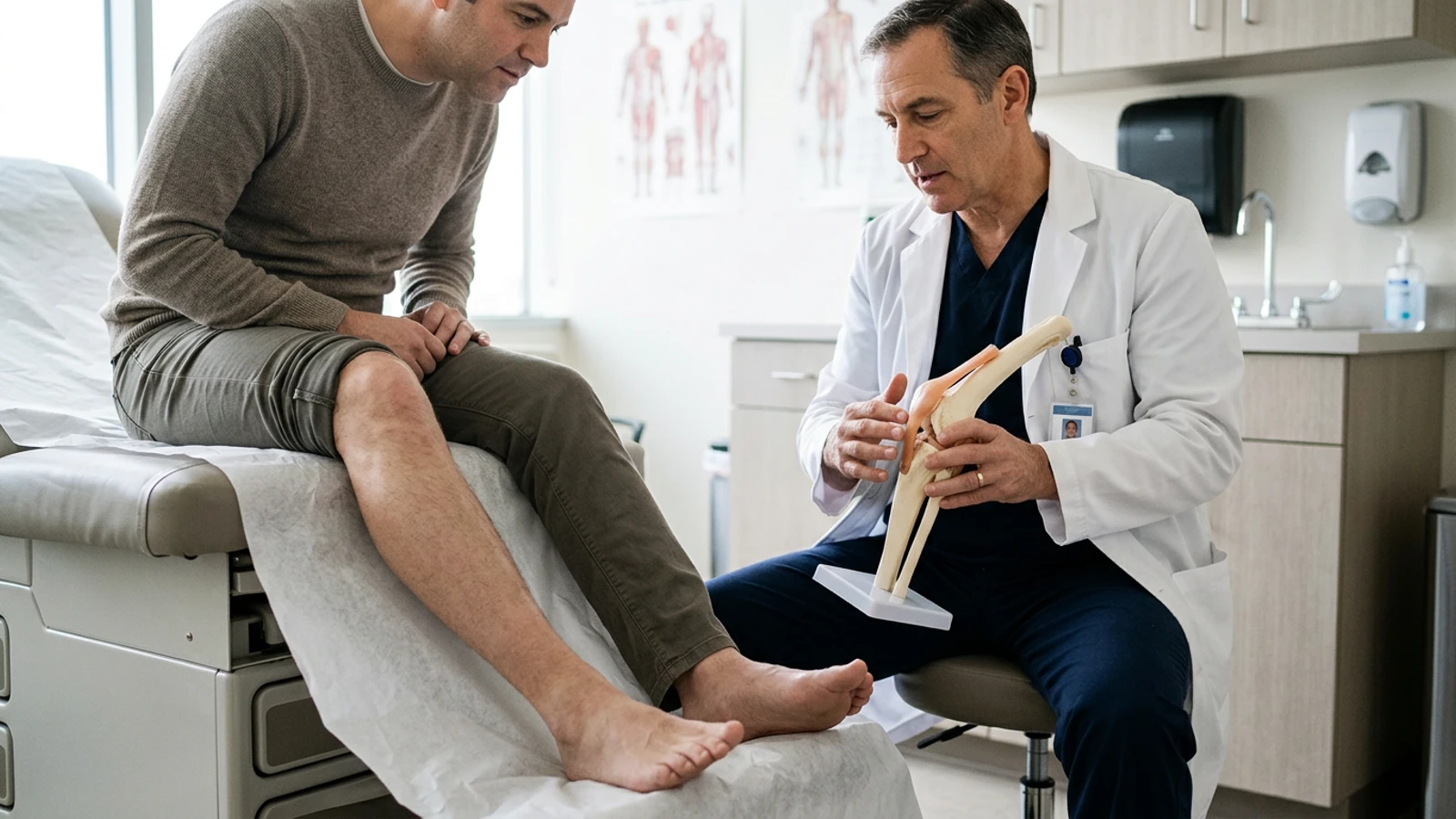
You may be able to walk down a hallway without much pain, then feel your knee slip as you turn through a doorway. After an anterior cruciate ligament (ACL) tear, that difference matters. When we discuss treatment, we want to know which movements you can trust, when the knee gives way, and what you need it to do again. The pain level alone cannot answer those questions. [1] [2]
Our practice offers both ACL surgery and physical therapy. The service links in this guide lead to our own practice.
What does it mean when the knee gives way?
The ACL connects the thighbone to the shinbone. It helps keep the shinbone from sliding too far forward and helps control rotation. Those jobs become especially important when your foot stays planted while the rest of you turns. That can happen when you change direction on a basketball court or turn away from the kitchen counter. A knee that feels dependable moving straight ahead may feel quite different during that turn. [1] [2]
Pain and instability can occur together, but they are not the same thing. Pain might make you stop halfway down a step because it hurts to continue. With instability, the knee shifts or folds before you mean to stop; you may have to catch yourself on the railing. Pain and swelling can also make it harder for the thigh muscles to support the knee. A buckle is worth describing, but it does not, by itself, tell us which structure is responsible. [1] [2] [3]
Think about the most recent episode. Was your foot planted? Did pain make you take weight off the leg, or did the knee slip first? Could you straighten it afterward? Tell us what you have stopped doing, too. A week without buckling because you avoided every stair and turn means something different from a week spent comfortably doing the things that matter to you. There is no need to recreate the episode to show us. [1] [2]
What to do after an injury or a new buckle
Call 911 now if the knee looks dislocated after an injury or the foot below it becomes pale, cold, or blue. A dislocation can damage blood vessels. Do not try to put the joint back in place. If a new knee injury leaves you unable to put any weight on the leg, have someone take you to the nearest emergency department now. Call 911 if you cannot get there safely. [4] [5] [6]
If the knee suddenly gets stuck and you cannot straighten it, contact a clinician right away for assessment rather than trying to force it straight. A twist followed by rapid swelling and loss of support also deserves prompt evaluation. Stop playing rather than trying one more turn to see whether the knee holds. [5] [6]
If you already have an ACL diagnosis and the knee starts giving way during ordinary activities, contact your treating team to reassess the plan. Explain what has changed: for example, it used to slip only during tennis, but now it slips getting out of the car. If you have been given instructions about crutches, a brace, or how much weight to put on the leg, keep following them until your clinician advises otherwise. [2] [5]
An isolated ACL tear is different from a combined injury
Partial and complete describe how much of the ACL is torn. Isolated means the ACL is the only injured structure. A complete tear can be isolated; a partial tear can occur alongside a meniscus tear or damage to the joint surface. Ask about both parts of the diagnosis. Knowing that some ACL fibers are still intact does not settle whether the knee is stable enough for your work or sport. [1] [2]
Each knee has two menisci, pads that distribute weight between the bones. Articular cartilage is different: it is the smooth covering on the ends of the bones. The same twist that tears the ACL can injure either kind of cartilage. A displaced piece of meniscus can block motion; rebuilding the ligament alone would not remove that block. When both the ACL and a meniscus are torn, preserving the meniscus when possible is a treatment goal. Our guide to meniscus symptoms and testing explains how we assess catching and locking. [1] [7] [9]
Repeated buckling matters even when the knee settles afterward. A study at several centers looked back at the records of 239 people who had ACL reconstruction. All had reported at least one giving-way episode before surgery. Surgeons found tears of the inner, or medial, meniscus more often in those who reported two or more episodes than in those who reported one. The study cannot tell us whether a particular buckle caused a tear. It does give us a reason to take repeated episodes seriously rather than waiting for them to hurt more. [8]
What the exam and imaging each tell us
At a knee evaluation, we start with the injury and what has happened since. A pop, early swelling, and difficulty continuing the activity are useful clues. We compare the knees, check motion and tenderness, and assess the other ligaments. After a significant injury, checking circulation and nerve function in the lower leg is also part of the exam. [1] [7]
You may hear the names Lachman and pivot shift. In the first test, the clinician feels how far the shinbone moves forward relative to the thighbone and how firmly that motion stops. The second checks for abnormal shifting as the knee turns. These are clinician-performed tests, not maneuvers to try at home. If pain and muscle tightening limit the first exam, a repeat examination after swelling settles may give better information. Looseness that we can feel on the exam table and the instability you experience on stairs are related, but we need to know about both. [2] [7] [10]
An X-ray can show a fracture, including a piece of bone pulled away where the ACL attaches. A normal X-ray does not rule out a torn ACL. The history and exam may establish the diagnosis; MRI can help confirm it and identify meniscus, cartilage, or other ligament injuries that could change treatment. [1] [5]
A follow-up MRI is not a return-to-sport test, either. An exploratory analysis followed active adults ages 18 to 35 with recent ACL tears. Of the 30 treated with rehabilitation alone through two years, 16 had an ACL that looked connected on MRI. Even a thin or stretched ligament could count as connected. At two years, this group reported better sport function and knee-related quality of life than those whose ACL still looked torn. The scan did not prove the ligament worked normally.
A later analysis of the same trial found that people whose unreconstructed ACL looked connected at five years may have had worse self-reported knee scores at 11 years, on average, than those who had early or delayed reconstruction. The comparison with people whose unreconstructed ACL still looked torn was uncertain. These small subgroups cannot establish cause or predict how your own knee will do. The useful question is not just whether fibers look connected, but whether the knee holds up during the activities you need. [11] [12]
What an exercise rehabilitation plan should help you decide
For a recreational adult with an isolated tear, a stable knee in daily life, and goals such as cycling rather than cutting or pivoting, starting with structured rehabilitation can be reasonable. Consider two people who both describe themselves as weekend athletes: one wants to ride a bike path, the other wants to chase down a shot on a tennis court. How often they play matters less to this decision than what their knee must do when they play. [1] [2]
Rehabilitation is active treatment. Early goals may include settling swelling, regaining the ability to straighten the knee, and getting the thigh muscles working well enough for a smoother walking pattern. As motion and strength improve, therapy can address balance and control when weight shifts onto the injured leg. Our physical therapy and rehabilitation team can work from the restrictions your physician sets, particularly if another structure also needs protection. [2] [9] [13]
Agree on a goal you can recognize and a time to review it. For example, a first goal might be managing the stairs to your apartment without the knee folding. At follow-up, describe whether you reached it, whether the knee swelled afterward, and whether you still have to change how you move to feel safe. Strength testing and observation can help distinguish a task you are ready to build on from one you are just managing to get through. [2] [13]
In the Delaware–Oslo study, athletes without substantial associated knee injuries worked through progressive rehabilitation before choosing a treatment with their clinicians. At ten years, those who chose rehabilitation alone had outcomes similar to those who chose early reconstruction. The groups were not assigned by chance: those choosing rehabilitation alone were generally older and less active. The lesson is that a supervised trial can inform a choice for selected patients, not that everyone should wait through repeated buckling. [13]
A new tear and persistent instability pose different questions
For adults with a recent complete tear, the COMPARE trial tested early reconstruction against rehabilitation with the option of later surgery. At two years, the early-surgery group reported less giving way and scored an average of 5.3 points higher on a 100-point knee questionnaire. The score difference was statistically significant but smaller than the lowest published difference considered meaningful to patients. Of the 82 people assigned to rehabilitation first, 41 had reconstruction during follow-up and 41 did not. The trial excluded people whose displaced meniscus tear prevented full straightening. [14]
The KANON trial followed young, active adults with recent tears. At 11 years, average improvement in patient-reported knee outcomes did not differ significantly between the early-surgery and rehabilitation-first groups. Later surgery was an option, so this was not a comparison of surgery with never having surgery. Professional athletes and people needing extensive meniscus repair were among those excluded. At 11 years, X-rays showed arthritis after both strategies. A separate analysis found signs of arthritis behind the kneecap in 41% of the early reconstruction group and 11% of the small group whose unreconstructed ACL still looked torn at five years. This comparison was not randomized and does not show that surgery caused arthritis. [12] [15]
The ACL SNNAP trial asked a different question: what helps adults past the initial injury whose knees still feel unstable? At 18 months, those assigned to a surgical strategy reported better knee outcomes on average than those assigned to rehabilitation first. That result speaks to persistent instability, not to a newly torn ACL or a meniscus injury that needs immediate surgery. If your knee keeps slipping despite treatment, it is reasonable to reopen the discussion. [16]
When to discuss reconstruction and its timing
Reconstruction uses a tendon graft, from your own body or a donor, to take over the stabilizing role of the torn ACL. Reasons to discuss it include buckling that interferes with ordinary life despite rehabilitation, work that requires unpredictable turns, a goal of returning to a pivoting sport, or another injury that needs surgical attention. If pain is your main limitation and the knee does not give way, ask which finding best explains the pain and what benefit reconstruction would realistically offer. [1] [2] [7]
Timing depends on why surgery is being considered. For a recent, isolated ACL tear when surgery is indicated, the American Academy of Orthopaedic Surgeons recommends early reconstruction. Its guideline says the risk of further injury to a meniscus or the cartilage covering the ends of the bones begins to rise within three months of the tear. The studies did not all find the same time threshold, and they did not establish that earlier surgery improves overall function or satisfaction. This is a reason to discuss timing promptly if you need surgery, not a three-month deadline for everyone with a torn ACL. Preparing the knee by reducing swelling and restoring motion can still be part of an early surgical plan. A displaced meniscus tear or multiple torn ligaments calls for its own timing discussion. [2] [7]
Surgery also means months of rehabilitation and carries risks, including stiffness, infection, blood clots, and another tear of the graft. Before choosing it, ask what better stability would let you do, what symptoms might remain, and how recovery would change if the surgeon also repaired a meniscus. Some meniscus repairs require limits on bending or weight-bearing that an isolated ACL reconstruction would not. [2] [9] [17]
Planning for work and home
Describe your actual shift rather than just your job title. Can you sit, or do you unload a truck, turn while carrying boxes, or climb steps with both hands full? Ask for written guidance that distinguishes tasks you can do from those that need temporary modification. The same applies at home: tell the team if you live upstairs, care for someone who needs lifting, or cannot get to therapy without driving. Those details belong in the treatment discussion before you commit to a plan. [2] [17]
If you choose surgery, arrange a ride home and ask who can show you how to manage your stairs with the prescribed support. Before discharge, make sure you and your therapist know what was actually done, how much weight you may put on the leg, and whom to call with concerns. Follow your own discharge plan, including brace settings, movement limits, and after-hours contact instructions. Another person's instructions for “ACL surgery” may describe a different operation. [9] [17] [18]
After reconstruction, call 911 immediately for chest pain or shortness of breath. For other symptoms, follow your own discharge instructions about what to report, including what temperature should prompt a call, when to call the surgical team, and which number to use after hours. [17] [18]
Growing children and athletes who need to pivot
A child who is still growing needs an assessment that considers the growth plates near the knee. A piece of bone can pull away at the ACL attachment and resemble a ligament tear. If reconstruction is being discussed, remaining growth influences the choice of technique. Waiting for growth to finish is not automatically safer when a child has a repairable associated injury, repeated giving way despite good rehabilitation, or restrictions that take them out of activities important to them. Ask for a plan from a clinician experienced with growing knees. [19]
For families, that plan needs to cover more than games. Ask what the child can do at recess, in physical education, and at team practice, and give the school and coach the same instructions. Include the child's own priorities: joining teammates for an approved part of practice is a different goal from being ready to defend against an opponent. [19]
For a high-demand athlete, a comfortable jog is encouraging, but it cannot tell us how the knee will respond to an unexpected cut. Our sports injury team can discuss those demands when weighing rehabilitation and reconstruction. Return is a progression from selected practice activities toward competition. The decision takes account of healing, swelling, motion, strength, movement quality, and confidence, not just elapsed time or the date of the next game. [2] [20]
Questions to ask your physician
- Does my description sound like the knee shifted, or could pain or weakness explain the buckle?
- Is the ACL tear isolated? Would a meniscus, cartilage, or other ligament injury change what we do first?
- Which movements should I avoid for now, and what can I safely do at work, at school, or at home?
- If we start with rehabilitation, what would count as success for my goals? Which changes should bring me back sooner?
- Would changing activities, such as choosing cycling instead of a pivoting sport, help me meet my goals without surgery? Would a brace have a role in that plan?
- If we discuss reconstruction, what benefit would you expect for me, and is there a reason timing matters? How do the graft options compare for the activities I want to return to?
- If my child is still growing, how will you account for the growth plates and decide when pivoting is appropriate?
Learn More
- American Academy of Orthopaedic Surgeons: ACL injuries, symptoms, examination, and imaging
- American Orthopaedic Society for Sports Medicine: The injured ACL
- Palmieri-Smith and colleagues: How knee pain and joint fluid affect thigh muscle activation and strength
- MedlinePlus: Dislocation first aid and when to call 911
- MedlinePlus: ACL injury, first aid, and emergency warning signs
- University of Utah Health: When a knee injury needs urgent or emergency assessment
- American Academy of Orthopaedic Surgeons: Clinical practice guideline on management of ACL injuries
- Sakamoto and colleagues: Giving-way episodes and associated injuries in patients awaiting ACL reconstruction
- ESSKA, AOSSM and AASPT: Formal EU–US consensus on rehabilitation after meniscus surgery
- Wang and colleagues: Exam findings after acute ACL injury in emergency care and at follow-up
- Filbay and colleagues: MRI evidence of ACL healing and patient-reported outcomes in the KANON trial
- Filbay and colleagues: ACL continuity on five-year MRI and outcomes at 11 years
- Urhausen and colleagues: Ten-year outcomes after rehabilitation and treatment choice in the Delaware–Oslo ACL cohort
- COMPARE randomized trial: Early reconstruction versus rehabilitation with the option of later surgery
- KANON randomized trial: Eleven-year outcomes after acute ACL tears in young, active adults
- ACL SNNAP randomized trial: Rehabilitation versus reconstruction for non-acute ACL injury with instability
- Ohio State University Wexner Medical Center: ACL reconstruction, preparation, recovery, and risks
- University of Washington Orthopaedics and Sports Medicine: ACL reconstruction postoperative instructions and warning signs
- International Olympic Committee: Consensus statement on diagnosis and management of pediatric ACL injuries
- Panther Symposium consensus group: How to assess readiness to return to sport after ACL injury