
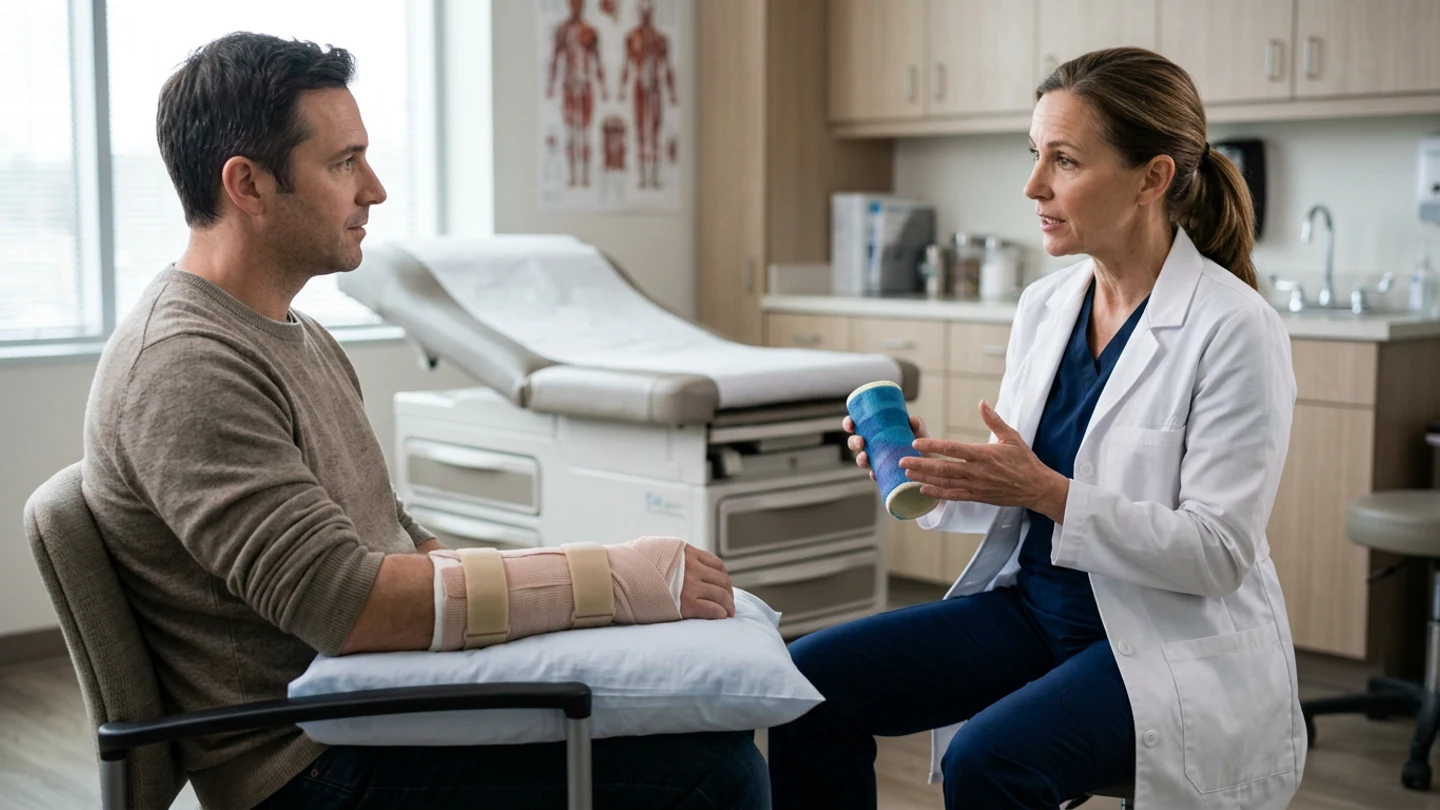
Your ankle feels better than it did in the emergency department. The swelling has gone down, but now your physician recommends a cast. Why would you need more support when the injury hurts less?
Swelling affects how a support fits. The injury determines what that support needs to hold still. A splint can protect a newly swollen ankle while leaving room for its shape to change. Once the swelling settles, a cast may fit better and hold the ankle in the position it still needs. That change can mean the original plan is working, not that the injury has worsened. For some injuries, the splint is all that is needed. [1]
Why a fresh injury often starts in a splint
A molded splint is more like a trough than a tube. Its firm part supports the injured area without making a rigid circle around it. Padding cushions the skin, and a wrap holds the splint in place. That design leaves more room for swelling than a closed cast does. The splint may extend well beyond the sore spot because movement at a nearby joint could move the injury, too. [1] [2]
A cast has a hard shell shaped around the arm or leg. It supports the injury on all sides, but the shell does not expand as the tissues swell or shrink as the swelling goes down. Sometimes a clinician applies a cast at the first visit and deliberately splits the shell to leave room. At follow-up, the clinician may reinforce that split with another layer or replace the cast if it has become too roomy. A planned split is different from a crack that develops during wear. [1]
The word splint can also mean a ready-made support with straps. A wrapped emergency splint may need to stay exactly as fitted until your next examination. With a strapped device, the important question is not whether it opens, but whether your treatment plan allows you to take it off, and for what purpose. Even with a fiberglass cast, whether a clinician can make it removable is a decision about the injury. [1] [2]
“It depends on the fracture and how stable it is,” says orthopedic surgeon Bruce E. Thomas, MD [3], explaining when a fiberglass cast can be made removable.
What makes an injury stable or unstable?
Alignment describes where the bone pieces are now. Stability describes how likely they are to stay in an acceptable position as the injury heals with the prescribed protection. If a clinician sets a broken bone without an incision, the procedure is called a closed reduction. An X-ray afterward can show that the pieces are back in a good position. It cannot promise they will stay there. [1] [4]
Consider a break in the fibula, the smaller lower-leg bone on the outside of the ankle. Some isolated breaks there leave the ankle joint lined up and stable enough for treatment in a boot. In another person, damage to the ligaments that hold the ankle together changes the decision. What matters is how the joint lines up, not just how small the break looks or whether you can take a step. When stability is uncertain, your physician may order another X-ray, sometimes with weight on the ankle under supervision. [5] [6]
In the PANCAKE ankle study, 147 people aged 16 or older were assessed. In 23, the joint looked lined up on the initial images but widened on weight-bearing X-rays about a week later. Those 23 had surgery and were not part of the treatment comparison. Fifty people whose ankles met the stability criteria were randomly assigned either to walk in a boot or to keep weight off in a cast. Being asked to stand for an X-ray is not the same as being cleared to walk at home. [7]
Nor does every abnormal test mean surgery is necessary. A 2026 Finnish trial studied a different group: 126 people with an isolated outer-ankle break whose joint lined up on the initial X-ray but widened when a clinician gently rotated the foot for a stress test. At two years, ankle function after six weeks in a cast was no worse, by the study’s prespecified standard, than after surgery followed by casting. The trial did not include ankles already out of alignment on the initial images. If surgery comes up, a useful question is: Which image or examination finding changes the choice for me? [8]
A full cast is not a guarantee against shifting, either. One study looked back at records for 500 adults whose wrist-end radius fractures had been set and did not extend into the joint. At one week, the bone had shifted again in 17% of those in a full cast and 29% of those in a plaster splint. The hospitals had not randomly assigned the treatments, so the difference cannot be attributed to the device alone. [9]
The later CAST trial included 420 adults whose displaced wrist-end radius fractures lined up acceptably after setting. The hospitals used the two treatments in a randomly assigned order. Within five weeks, shifting was seen in 47% with a plaster splint and 49% with a full cast, not a statistically significant difference. The splint group reported somewhat more pain in the first week. Those figures are not the odds for every broken wrist. The practical point is to keep a scheduled position check even if the cast feels secure. [10]
What can change at the follow-up visit?
It helps to know what the visit is meant to decide. Is the team checking whether the support still fits, whether the bone has moved, or whether it is time to allow motion? Those are different questions. Tell the team what you have noticed since you left, including whether your arm or leg now slides inside the support. The examination can include the skin, swelling, feeling and circulation. If another X-ray is needed, ask to see what your physician is comparing with the earlier image. [1] [4] [6] [11]
The next step may be to:
- Keep the existing splint. If it fits and provides enough protection for this injury, less swelling is not, by itself, a reason to change it. Ask whether the splint is now the treatment through healing or still a temporary measure until another check. [1] [2]
- Change from a splint to a cast. Your arm or leg may now be easier to fit closely while the fracture still needs firm protection. Replacing a loose cast with a new one can serve the same purpose: restoring the fit, not starting treatment over. [1]
- Allow some motion. A small, nondisplaced crack in the radial head, the end of a forearm bone at the elbow, may need only a brief time in a sling or splint. Gradually bending and straightening the elbow can be part of treatment. Permission to bend it is different from permission to carry groceries with that arm. [11] [12]
- Reconsider how to hold the bone in position. If the bones have shifted, a better-fitting version of the same device may not solve the problem. Depending on the injury, options may include setting the bone again, changing the support, or surgery to hold the pieces in place. Ask what changed on the images and how to protect the limb while you and your physician decide. [5] [6] [10] [11]
When a removable support may be enough for a child
A buckle fracture at the wrist end of a child’s radius is one example where a rigid cast is usually unnecessary. Part of the growing bone buckles under pressure rather than breaking into pieces that need to be lined up again. In one trial, children ages 6 to 15 with buckle fractures of the radius, ulna or both at the wrist were assigned to a removable splint or a short arm cast. Children in splints reported better function at two weeks and less trouble bathing. The researchers did not find a significant difference in pain. [11] [13]
A larger UK trial asked a different question. In 965 children ages 4 to 15 with a distal radius buckle fracture, offering a soft bandage and immediate discharge produced equivalent pain scores at three days compared with rigid support and usual follow-up. UK guidance says routine review is usually unnecessary after assessment of this particular fracture. Several of these studies took place outside the United States; your child’s follow-up arrangements may differ. Ask for the exact fracture name, and keep any appointment your child’s team has requested. [11] [13] [14]
A removable boot has also been studied for a specific shinbone injury called a toddler’s fracture. Four Canadian children’s hospitals enrolled 129 children ages 9 months to 4 years who could bear weight before injury. To qualify, the emergency physician had to identify an isolated break in the lower two-thirds of the shinbone on X-ray, with the bone ends displaced by less than 2 millimeters. Families assigned to the boot could remove it; they were advised to use it for one week and then as needed for up to three weeks in total, without a scheduled physician visit. [15]
At four weeks, pain with the boot was no worse than with a cast by the trial’s standard. Among families who completed that check, 77% in the boot group and 41% in the cast group said their child was back to usual activities almost all the time. Fewer boot-group caregivers reported difficulty with bathing or carrying their child. Follow-up was more complete in the boot group: 64 of 65 families, compared with 54 of 64 in the cast group. [15]
Rashes, redness or pressure sores were reported more often with the boot: 72% versus 50% with the cast. Most were mild redness; there were five early-stage pressure sores in the boot group and one in the cast group. The difference in overall skin problems was not statistically significant, but it is a good reason to ask for a demonstration of skin checks. A U.S. hospital that introduced boots along with staff training and caregiver instructions did not find a statistically significant change in overall skin breakdown compared with its earlier practice. Neither study shows that a boot by itself protects the skin better. [15] [16]
If a boot is offered, ask who will help with it at daycare and whether that person can follow the same wear and skin-check instructions you received. These studies can help a family choose between treatments for a diagnosed injury. They are not a reason to put a limping child in a borrowed boot. [15] [16]
Looking after the fit you have
Notice what happens during ordinary activities rather than testing the fit by sliding fingers or objects under the lining. Does the support stay where it was fitted, or does it slide when you get out of a chair? Is the edge rubbing the same patch of skin? That description gives the team something specific to check. Do not cut the shell, pull out the padding or add padding of your own. Adjust a splint only in the way the treating team has shown you. [1] [17]
For ordinary swelling, follow the positioning instructions you were given. When resting, that may mean using pillows to support the arm or leg above heart level. For bathing, assume the lining needs to stay dry unless the team specifically identified it as waterproof. A fiberglass shell does not make the padding waterproof. With a standard cast, a cover protects against splashes; it is not permission to submerge the cast in a tub or hold it under the shower. [1] [2] [4] [17]
If you have reduced feeling in a foot, diabetes or a history of circulation trouble, mention it when a leg support is fitted. Ask which areas you or a caregiver can see without removing it and whether your follow-up should be different. With a removable support, get instructions for checking the skin as well as for wearing the device. With a fixed cast, leave the lining in place and keep objects, lotions and powders out. [1] [4] [6] [16]
Walking, lifting and getting through the day
A walking boot is the name of a device, not a weight-bearing order. You might be allowed to walk in it, to put only limited weight on the leg, or to keep weight off entirely. Ask for directions that cover the trip from bed to bathroom, not just longer walks outdoors. If your plan says no weight, a few steps across the room still count. Changing from a cast to a boot does not, by itself, change that order. [2] [4] [5] [7]
The same distinction matters with an arm injury. Being able to move your fingers does not tell you whether you can push up from a chair or lean on a walker. If you normally need both hands to get around, tell the team before you leave. For a leg injury, mention stairs at your entrance or a bathroom on another floor. Ask someone to show you how to use the prescribed walking aid for the route you actually have at home. [11] [18]
For work or school, describe the task rather than asking only whether you can go back. A student might be able to attend class but need help with a backpack and stairs. An employee who can work seated might still be expected to lift boxes or stand at a counter. Ask for written restrictions that distinguish attendance from lifting, walking, sports or driving. With a removable device, get separate instructions for sleep, washing and activity. [2] [4] [11]
Making sure the next check happens
If you were splinted away from home or referred from an emergency department, look at the discharge sheet before booking. Find out who is responsible for the next examination and whether the appointment has actually been made. Ask whether the receiving office can see the original X-rays, including any taken after the bone was set, or whether you need to bring copies. If the available appointment is later than your discharge plan specifies, tell the referring team rather than silently extending the wait. [4] [10] [11]
Bring the instructions you have been following. Before leaving with a new cast or brace, ask what changed and what stayed the same. You may have a new device but the same lifting limit, or permission to remove a brace for washing but not for walking. If the verbal and written directions differ, ask the team to reconcile them and give you one plan to take home. [2] [11]
Questions to ask your physician
- What exactly is injured, and what tells you it is stable or might still shift?
- Is this splint protecting the injury until another decision, or can it be the treatment through healing?
- At my next visit, are you checking the fit, the position of the bone, or readiness for movement? What would change the plan?
- If my support is removable, when must it stay on? Can you show me how to put it back on correctly?
- How much weight can I put through this leg or arm? What does that mean for stairs, lifting or using my walker?
- Which contact in my written instructions should I use if the fit changes before my appointment, including after hours?
When to get urgent help
Call 911 now if a new injury causes severe bleeding or bone is sticking through the skin. During recovery, call 911 for sudden shortness of breath, new unexplained chest pain, coughing up blood or fainting. These can be signs of a blood clot in the lungs, even if you have not noticed calf pain or swelling. Do not wait for the orthopedic office. [19] [20] [21]
Go to the nearest emergency department now for severe pain under a cast or splint that keeps getting worse or is much more intense than expected. Dangerous pressure can build inside the muscles after an injury; do not wait for the fingers or toes to change color. Also go now if the fingers or toes become cold, pale or blue, newly numb, or difficult to move. If you cannot get there safely, call 911. [4] [22] [23]
Call the care team or the specific contact in your written discharge instructions right away for increasing tightness with pain, new pins and needles, burning or stinging, or increasing swelling beyond the edge of the support. If you cannot reach that contact promptly, cannot get prompt assessment, or any of these symptoms worsen while you wait, go to the nearest emergency department. This applies after hours, too. [1] [4] [22] [23] [24]
Get medical assessment the same day for new, unexplained calf pain, swelling on one side, warmth or redness. These can be signs of a clot in a deep vein. Contact your treating team promptly; if you cannot get assessed promptly through that route, go to an emergency department. [20] [21]
Call your treating team the same day for fit or skin problems if the cast slips, cracks, develops a soft spot, gets soaked inside, or has drainage or a strong foul odor. Call about fever or chills as well, following any specific directions on your discharge sheet. For routine scheduling, records or paperwork, use the clinic contact in your written instructions during business hours. [1] [4] [11] [17] [23] [24]
Learn More
- American Academy of Orthopaedic Surgeons: Care of Casts and Splints
- Pediatric Orthopaedic Society of North America: Recovering from Orthopaedic Injury: Weight Bearing, Activity Restrictions, Managing Casts & Splints
- University of Utah Health: Modern Casts for a Broken Bone — interview with Bruce Thomas, MD
- MedlinePlus: Closed reduction of a fractured bone - aftercare
- American Academy of Orthopaedic Surgeons: Ankle Fractures (Broken Ankle)
- British Orthopaedic Association: BOASt - The Management of Ankle Fractures
- Prospective randomized controlled trial: early weight bearing after conservative treatment of Weber B ankle fractures (pancake trial)
- Cast immobilisation versus surgery for unstable lateral malleolus fractures (SUPER-FIN): randomised non-inferiority clinical trial
- Does circumferential casting prevent fracture redisplacement in reduced distal radius fractures? A retrospective multicentre study
- Redisplacement of reduced distal radius fractures in adults: does the type of casting play a role? The CAST study, a multicentre cluster randomized controlled trial
- National Institute for Health and Care Excellence: Fractures (non-complex): assessment and management — guideline NG38
- American Academy of Orthopaedic Surgeons: Radial Head Fractures of the Elbow
- A randomized, controlled trial of removable splinting versus casting for wrist buckle fractures in children
- Immobilisation of torus fractures of the wrist in children (FORCE): a randomised controlled equivalence trial in the UK
- Removable Boot vs Casting of Toddler’s Fractures: A Randomized Clinical Trial
- Outcomes of Toddler's Fractures After Implementation of Comprehensive Care Management Protocol With Controlled Ankle (CAM) Boots
- Washington University Orthopedics: Cast and Splint Care
- American Academy of Orthopaedic Surgeons: How To Use Crutches, Canes, and Walkers
- MedlinePlus: Broken bone
- Centers for Disease Control and Prevention: About Venous Thromboembolism (Blood Clots)
- MedlinePlus: Pulmonary embolus
- American Academy of Orthopaedic Surgeons: Compartment Syndrome
- UCSF Benioff Children’s Hospitals: Cast Care
- The CORE Institute: Cast Care — patient instructions and emergency department fallback