

A lumbar herniated disc is a change in one of the cushions between the bones in your lower back. A portion of the disc can extend beyond its usual boundary and sometimes irritate a nearby nerve. That can cause pain down a leg, tingling, numbness, or weakness. Disc changes also appear on scans of people without pain. To decide whether a herniation explains your symptoms, a clinician matches the pattern of your symptoms and the results of a nerve exam with imaging when imaging is useful. [1] [2] [3]
When to seek emergency care
Go to an emergency department right away if back or leg symptoms come with new trouble starting urination or emptying your bladder, loss of bladder or bowel control, or numbness between the legs or around the genitals or anus. These are possible signs of cauda equina syndrome, in which several nerves at the base of the spine are compressed. Severe or rapidly worsening weakness in one or both legs also needs emergency assessment. Seek same-day advice for new, milder weakness. Report fever, a recent serious infection, a history of cancer, or a significant injury when seeking care, since these can change the urgency of the evaluation. [2] [4]
What happens to the disc
Each disc sits between two vertebrae. It has a tough outer layer and a softer center. A herniation is a localized extension of disc material. Where it extends matters because the nerves that serve the leg pass near the discs. A nerve problem can produce leg symptoms even when your back doesn't hurt much. When pain travels down the leg, clinicians may call it sciatica. A herniated disc is one possible cause of sciatica. [1]
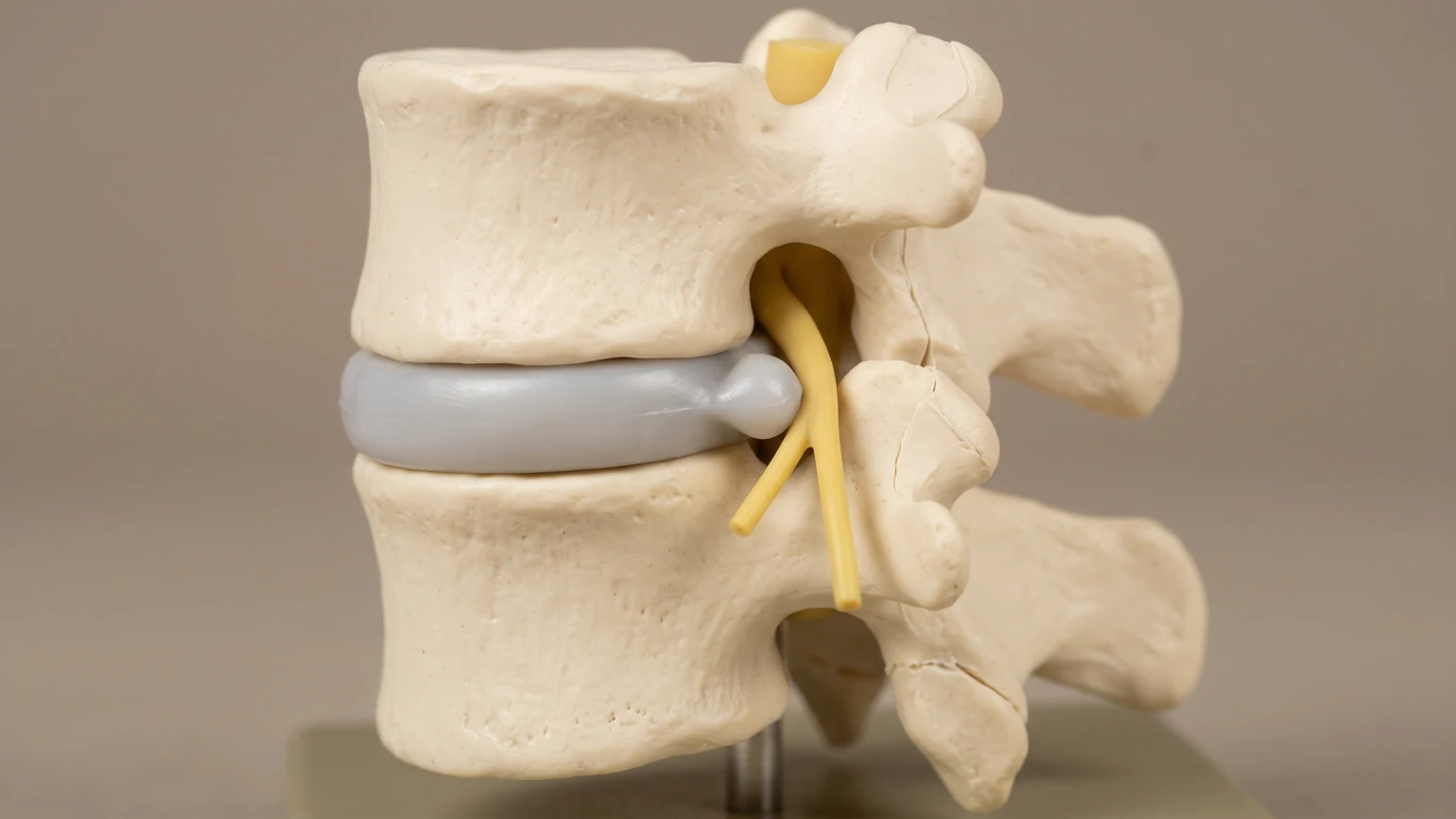
Simplified teaching model. A disc can extend toward a nerve, but the location of a scan finding must fit the symptoms and exam. [1] [3]
- Vertebral body. The main weight-bearing part of one spinal bone.
- Intervertebral disc. The cushion between adjacent vertebrae.
- Disc herniation. A localized extension of disc material.
- Nerve. A nearby nerve may be irritated if the extension reaches it.
What to tell your clinician
Describe where the pain starts and the farthest point it travels. Say which leg is involved, where you feel numbness or tingling, and when the symptoms started. If everyday movements have changed, give a specific example. The foot starts catching on the floor, a leg gives way on stairs, or walking becomes harder over a few days. Those details help distinguish a change in function from pain alone. [1] [4]
A clinician may compare muscle strength, sensation, and reflexes between the legs. The exam may include gently raising the leg while you're lying down to see whether it reproduces your usual leg pain. Findings can point to a particular nerve or suggest a problem outside the spine. The result of one maneuver is only one part of the evaluation. [1] [4]
When a scan can change the plan
For new back or leg symptoms without concerning findings, imaging usually isn't needed at the first visit. The American College of Radiology considers MRI appropriate in several circumstances, including when serious nerve compression is suspected, or when symptoms persist or progress despite about six weeks of appropriate nonsurgical care and an intervention is being considered. Six weeks is a guide for that second scenario. Earlier assessment and imaging may be appropriate when there are red flags or a progressing nerve problem. [2]
A plain X-ray mainly shows bones and alignment. MRI can show discs and nearby nerves in more detail. Ask what question the clinician wants the scan to answer. An MRI finding matters more when it matches the side, symptom pattern, and exam. A systematic review found disc changes, including protrusions, in people who reported no pain. For example, if a finding is on the right and your symptoms are on the left, the clinician may look for another explanation. [1] [2] [3]
What happens after the evaluation
Many people with symptoms from a lumbar herniated disc improve with nonsurgical care. If the exam does not point to an emergency, ask what activity is reasonable now, how symptoms will be monitored, and whether physical therapy makes sense for your situation. If weakness is progressing or pain and disability persist despite treatment, a spine specialist may discuss further options. Suitability for surgery depends on the findings, your goals, and the procedure being considered. Confirm any restrictions and recovery plan with your own surgeon and rehabilitation team. [1] [4]
Questions to ask about your result
- Do my symptoms and exam point to a particular nerve?
- Are there changes in strength or sensation that we should recheck?
- Would imaging change my treatment now? If we wait, what would prompt a scan?
- If the scan shows more than one disc change, which one fits my symptoms and why?
- What symptoms should send me to urgent or emergency care?