
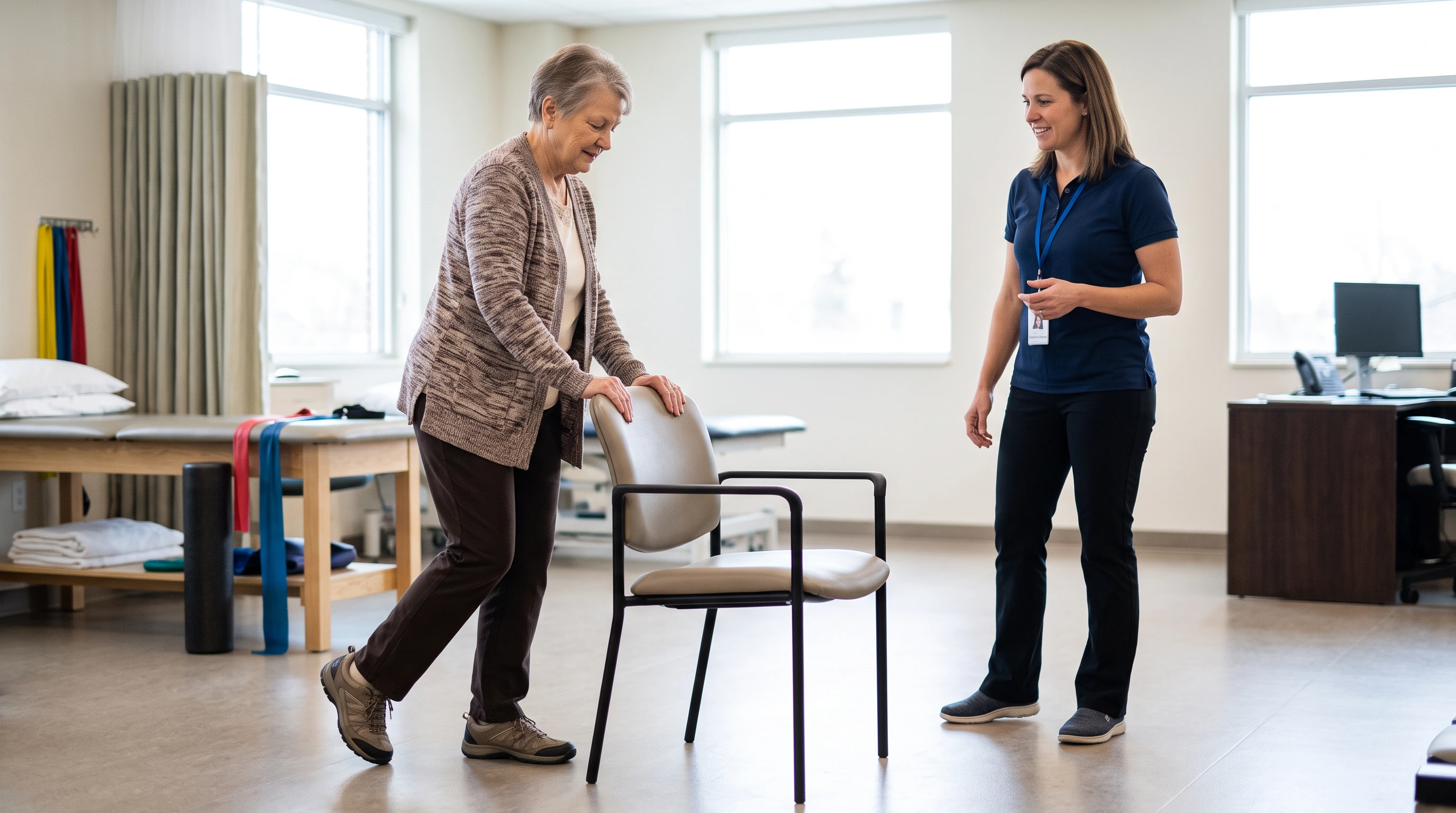
If you can do your exercises at home, what is the next physical therapy visit for? Ideally, there’s a specific answer: to find out why you still need help on the front steps, check a movement that feels different at home, or decide whether you’re ready to do more on your own.
Physical therapy (PT) and home exercise often belong to the same plan. The assessment helps you choose what to practice. Practice shows how it works in your life. Follow-up gives you and your therapist a chance to use that information rather than simply repeat the last visit. The right question isn’t always how many visits to book. It’s what you can safely do between visits and what you still need a therapist to help you decide. [1]
What a therapist can change in the room
Start with a task you want back. Wanting your knee to feel better is a good starting point. Knowing that you can get into a restaurant booth but need someone to pull you up afterward gives the therapist something to examine. For a shoulder problem, the useful detail might be that you can reach an empty shelf but can’t put a dinner plate on it. You don’t need to identify the muscle or joint responsible before asking for help.
A therapist can watch where the task breaks down. Is it difficult to rise from any seat, or mainly from one that is low and has no armrests? Is pain what stops you, or do you feel unsteady partway up? The therapist may check strength, joint motion and balance, then change the setup and watch again. An in-person visit also allows a hands-on exam when that would help answer the question. [1]
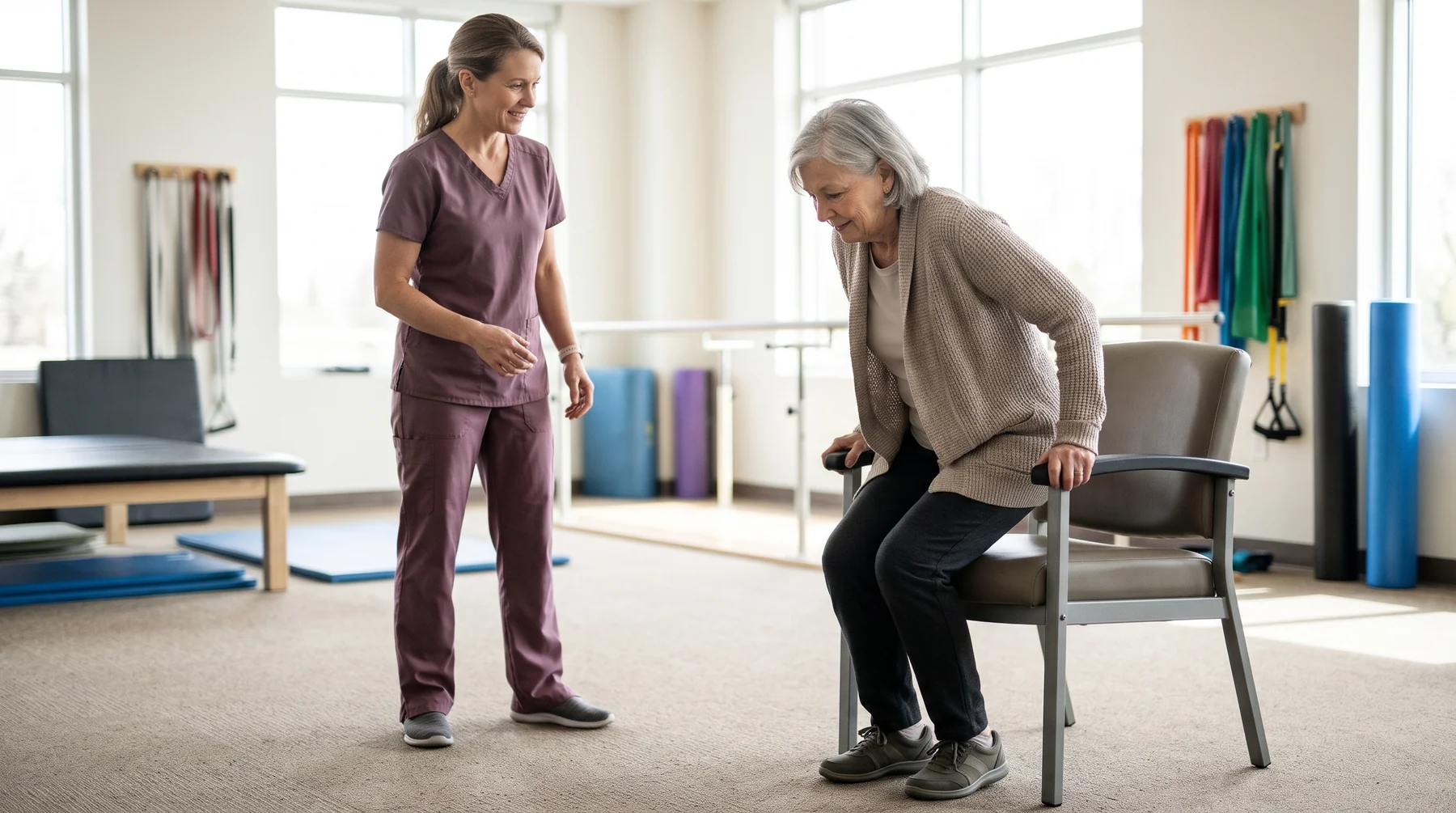
If the clinic chair has armrests and yours does not, tell your therapist. Ask to practice with a setup you can actually use at home.
What the therapist learns should change something for you: the movement you take home, the support you use, the amount you do, or the decision to have the problem evaluated another way. Before leaving, ask what the therapist noticed. If you came for help with stairs and are leaving with an exercise you do sitting down, you should understand the connection. [1]
For paperwork, clothing and what to bring, see our guide to your first orthopedic physical therapy visit. For the visit itself, bring one detail the exam room can’t supply: which side the stair rail is on, how high the shelf is, or what you have to carry at work. A description is enough; you don’t need to repeat a difficult task just to photograph it.
Leave with a home plan you can use without guessing
An exercise name is not a full set of instructions. Before you leave, you should know where to do the movement, what support to use, how much to do and what it is meant to help. Ask the therapist to distinguish the exercises you practiced together from the ones you should actually do alone. Those lists need not be identical. [1]
Try the home movement while the therapist watches. Then explain, in your own words, how you’ll set it up when you get there. This is sometimes called teach-back: you explain or show what you understood so the person teaching you can clarify it. It isn’t a memory test. Use the handout. If the drawing and the demonstration seem different, point to the difference while someone can help you resolve it. [2]
Here are useful things to have on your copy of the plan:
- The purpose. Which task am I working toward? Am I practicing moving farther, getting stronger, keeping steady or doing part of the task itself?
- The setup. Which side am I working? Where do my hands go? What chair, support or equipment did we agree on?
- My amount. How far should I move? How many times, for how long and on which days? If I’m using resistance, which band or weight did we try?
- My options. Is there a version you’ve approved for a difficult day? Which changes can I make myself, and which should I check with you first?
- The next decision. What should I notice before we speak again? How do I reach the right person if I can’t follow the instructions?
Be specific about anything that won’t work at home. If you can get down onto a clinic mat but can’t get up from the floor by yourself, say so. Ask to try a different position rather than inventing a way to haul yourself up on furniture. If small print is hard to read, ask for larger print. If several sheets look alike, have the therapist date the current one and mark which older instructions it replaces. A clear page you can use is worth more than a folder of exercises you’re afraid to try.
What to track when symptoms change from day to day
Pick an ordinary activity you already do, not a test you have to push yourself to complete. It might be getting out of your usual car seat, standing at the sink to wash dishes, or pulling a shirt over your head. Describe what it takes today. Do you need help? Do you stop halfway? Can you finish, but only by changing how you move? That gives you something to compare besides how you felt on one particular afternoon. [1]
A few lines are enough:
- What I did: the version of the exercise I actually used, including any part I left out.
- What else was different: a long shift on my feet, a car trip, a lower chair or help from someone at home.
- What happened: where I felt symptoms, whether they were familiar, and what I noticed later that day or the next morning.
- What I could do: whether my ordinary task was easier, unchanged or harder with my usual support.
Suppose you did the knee exercise as shown and also stood through your granddaughter’s concert. Your knee ached more that evening, but getting out of your kitchen chair felt about the same the next morning. That account doesn’t prove what caused the ache. It gives your therapist a better starting point than a pain score alone. The reverse matters, too: your shoulder may ache about as much as before, but now you can put the plate away yourself.
With diagnosed arthritis, some discomfort or stiffness can occur when you start a new activity. That does not mean you should push through every increase. Ask what response is acceptable for your plan. If a movement repeatedly leaves you less able to do your usual activities, describe that pattern before making it harder. Advice for a familiar arthritis fluctuation is not a rule for a new injury or for recovery after surgery. [3]
Give each follow-up visit a job
Bring the current instructions and one example of what changed at home. If your question is about technique, show how you actually do the exercise, including the support you use. If the question is whether it’s helping, start with your chosen task. Repeating a relevant movement or measurement gives you and your therapist a way to compare today’s result with the first assessment. [1]
The decision isn’t always to add another exercise. A follow-up might lead you to:
- Keep the plan. The task is getting easier, the instructions make sense, and you can practice as agreed. Ask what the next sign of progress might be and whether visits can be spaced farther apart.
- Replace an exercise. You can do it in the clinic but not in the space you have, or you need someone to cue you each time. Try the replacement together and cross the old version off the sheet.
- Change the goal. You can reach the shelf now, but your job also requires holding an object there. Explain the difference so you’re working toward the task you need to do.
- Reassess instead of advancing. You’ve practiced as instructed, but the task is getting harder or a different problem is limiting you. Ask what needs another look and whether your physician should evaluate the change. [1]
Distinguish a plan that didn’t help from one you couldn’t try. If the band was too difficult to grip, the instructions were unclear, or your work hours changed, say exactly that. Otherwise, the next version may be built on the mistaken assumption that you completed the first one. An accurate account of a difficult week is more useful than a fully checked exercise sheet.
Before ending the visit, settle one question: What are we checking next time that I can’t decide on my own? We offer physical therapy at our practice. It’s reasonable to ask about the purpose and cost of the next one, and about alternatives. If no visit is needed for now, agree on what would bring you back.
Make home practice fit the week you actually have
If remembering is the problem, a paper check mark or phone reminder may help. If the problem is finding private space during a split shift, a reminder will just interrupt you at work. If you’re worried about doing the movement incorrectly, you may need someone to watch you try it. Name the obstacle before choosing a solution.
Tell the therapist if you care for a family member and can’t count on a long uninterrupted stretch. Ask which parts of the program have priority and whether any can be separated. If a particular workday is physically demanding, describe what you lift, carry or climb. Ask how that fits with the prescribed amount instead of quietly skipping exercises on workdays and doubling up on a day off.
Two trials illustrate the difference between doing the exercise more often and getting a better result. In one, people with knee osteoarthritis and obesity who received text support reported exercising on more days than people without the texts. The researchers didn’t find an added benefit for pain or physical function at 24 weeks. [4]
In a separate trial, 182 Australian adults with knee osteoarthritis and difficulty with everyday movement learned home strengthening in two video visits with a physical therapist. Some also received a tracking and goal-setting app. At 26 weeks, more people in the app group reported following their exercise schedule. The app group did not report better physical function. [5]
Use a reminder if it solves a problem for you. Keep a separate question for follow-up: Is the activity I care about getting easier? If not, a record showing that you practiced is a reason to revisit the plan, not a reason to repeat it unchanged.
What knee osteoarthritis studies do and don’t tell us
For adults with knee osteoarthritis, the American Academy of Orthopaedic Surgeons recommends exercise over no exercise to improve pain and function. Options include supervised exercise, independent exercise and exercise in water. European hip and knee osteoarthritis guidance also advises choosing a format that fits your preferences and the services available to you. Neither gives everyone the same clinic schedule. [6] [7]
There are reasons to ask for more support. In its 2026 guideline summary, the American College of Rheumatology advises PT referral when loss of function, worsening pain or increased fatigue gets in the way of exercise or daily activities. It advises occupational therapy when arthritis interferes with daily tasks, particularly those using the arms or hands, or makes it difficult to fulfill work or social roles. If hip or knee arthritis limits walking, ask whether a cane or another mobility aid would help. These are good-practice statements; the recommendation to exercise for hip or knee arthritis is a separate, strong recommendation. [8]
What the four-group meniscal tear trial actually tested
The TeMPO trial included 879 adults ages 45 to 85 with knee pain, arthritis changes on imaging and an MRI-confirmed meniscal tear in the painful part of the knee. Their physicians thought the tear explained at least some of the symptoms. People with the most advanced X-ray grade of arthritis were excluded. This was nonsurgical care for a degenerative tear, not rehabilitation after a repair. [9]
Everyone received a three-month home program with strengthening, stretching, written and video instructions, and ankle weights. One group had that program alone; another also got reminder texts. Two other groups had the program and texts plus therapist visits. Standard visits included supervised exercise and hands-on treatment. Comparison visits included simulated treatment, such as ultrasound with no energy delivered. Nobody was assigned simply to figure out what to do at home. The two visit groups were scheduled for 14 one-on-one, half-hour visits over three months. The researchers caution that results may differ with longer visits, group sessions, or another schedule. [9]
At three months, average pain relief ranged from about 17 to 20 points across the four groups on a 100-point scale. The standard-visit group improved by 2.5 points more than the home-only group. The uncertainty around that difference included both slightly less relief and slightly more relief with visits. Adding texts alone didn’t clearly improve pain either. Standard and simulated visits produced similar pain results. That doesn’t tell us which part of a visit mattered. [9]
At six months, the standard-visit group averaged 4.1 points more pain relief than the home-only group (95% confidence interval, 0.7 to 7.6). At 12 months, the estimate still favored standard visits by 2.5 points, but the interval ran from 1.2 points worse to 6.2 points better. Pain scores in the standard- and simulated-visit groups tracked closely over time. The researchers caution that these later comparisons were secondary and were not adjusted for the number of comparisons. They did not establish a lasting advantage for standard visits. [9]
An earlier trial asked a different question. In 134 people with knee osteoarthritis, both groups learned the same home exercises, and the home group had a clinic visit to review them. At four weeks, the group that also received supervised exercise and individualized hands-on therapy improved more on a questionnaire about symptoms and function. Walking distance improved by about the same amount in both groups. At one year, both groups remained similarly improved from where they started. [10]
If you resemble the TeMPO participants, a well-explained home program is a reasonable option to discuss. The trial didn’t show that a generic video equals an assessment, or that every participant recovered. Because everyone exercised, it can’t tell us how much improvement exercise itself caused. The 2026 U.S. VA/DoD hip and knee arthritis guideline likewise found no consistently best exercise format. For you, the deciding issue may be something a pain score won’t capture: whether you can use the stairs safely or carry out the plan without help. [9] [11]
After surgery, the surgeon’s restrictions come first
After a repair, the first goal may be getting from your bed to the bathroom within a restriction, not walking farther. Your surgical team sets limits to protect what was repaired. Your therapist uses those limits to teach movements you need every day. Feeling better is useful information, but it does not by itself lift a restriction. [12] [13]
Meniscus repair is one example. Depending on the tear and repair, one person may be allowed to put weight on a straight leg early on; another may need crutches to keep weight off the leg. Allowed knee bending can differ, too. Progress can depend on healing time as well as swelling, motion and muscle control. Someone else’s instructions after knee arthroscopy may describe an entirely different procedure. [12] [13]
Bring your discharge plan to PT. Have the therapist translate it into the tasks you face: getting into the passenger seat, negotiating the steps at your entrance, putting on clothes or reaching the bathroom at night. Ask which tasks you may do independently, which need another person and which must wait. If a handout seems to conflict with your surgeon’s instructions, keep the restriction in place and have the therapist and surgical team clarify it before trying the disputed movement. [12] [13]
Replacement surgery has its own evidence. The American Physical Therapy Association’s 2026 total knee replacement guideline recommends therapist-supervised care. Where it happens should take account of safety, mobility, your home and the help you have. Supervision does not necessarily mean traveling to a clinic for every session. The guideline allows digital care as an option when it can be delivered safely. [14]
Before discharge, clarify what at home means. A home health PT visit means a clinician comes to you; a home exercise program is the practice you do as instructed. Ask who is arranging the next visit, what equipment should be waiting when you arrive, and whom to contact if the expected visit isn’t scheduled. Keep the surgical follow-up on your discharge plan even if the exercises are going well. [14] [15]
When a video check-in is worth asking about
A live video visit can be useful when the question is something the therapist can see. Perhaps the exercise worked at the clinic, but at home your chair meets the wall before there is room for your walker. Video can show that problem in its actual setting. If the therapist needs to examine the joint by hand or be beside you to prevent a fall, ask for an in-person visit instead. [1] [16]
In the Australian PEAK trial, 394 adults with chronic knee pain consistent with osteoarthritis were assigned to five PT consultations over three months, either by live video or in person. Both groups received help with strengthening, physical activity and education. At three months, video care met the study’s standard for not being meaningfully worse for pain or physical function. This was therapist-led care in both groups, not a test of prerecorded workouts. It does not settle how a new injury or a postoperative concern should be assessed. [17]
Before booking, ask what the therapist needs to see, whether anyone should be present and what to do if the connection fails. Put the device on a stable surface. If getting into camera view means giving up a needed handhold, tell the therapist; don’t give up the handhold. Ask the clinic and your insurer about availability and cost rather than assuming video is offered or costs less. [16]
Frequently asked questions
If I already know the exercises, what can an in-person therapist change?
Bring the task that still gives you trouble. Being able to raise your arm is different from being able to lower a dinner plate onto a shelf with control. A therapist can watch that part of the movement, examine strength or joint motion, and help decide whether you still need the original exercise. Knowing it by heart doesn’t mean you need to keep doing it indefinitely. [1]
What if I can’t remember how far to move or which band to use?
Check your current instructions. If the detail isn’t there, ask before guessing at the resistance or range. Name the exercise and what’s missing. At the next visit, have the therapist mark your copy and watch you set it up yourself. That gives both of you a chance to catch a misunderstanding before you’re home again. [1] [2]
Does walking at work count as my home exercise?
It counts as activity worth telling your therapist about. It may not practice the particular strength or movement your plan targets. Describe a typical shift, including whether you carry anything or use stairs. Ask which parts of work and the home plan serve the same purpose, and how to fit the rest around them. [6] [7]
Should I make up missed exercises before my next visit?
Don’t add sessions or resistance on your own to catch up. Tell the therapist what you missed and ask how to resume your plan. If the reason was uncertainty, equipment or a change in symptoms, keep the visit if you can: solving that problem may be the most useful part of the appointment. [1]
My pain comes and goes. Which day should I describe?
Describe a typical day and one that was noticeably different. Say what you were doing, what help you needed and whether you returned to your usual level afterward. Include a good day, too. Being able to finish making dinner without sitting down matters, even if your knee ached again later. You don’t need a complete diary to give a useful account. [1] [3]
What can a family member help with safely?
With your permission, they can take notes, clear space or help set up a video call. If you need physical help getting between seats or using stairs, ask the therapist to teach both of you that specific task. Don’t leave a family member to improvise a lift, push a joint farther or decide it’s time to stop using a brace. [1] [12] [15]
I feel ready to do more after surgery. Who clears the next step?
Ask whether the change is one your therapist is already authorized to guide or whether it would change a surgical restriction. Permission to do a harder version of one exercise is not permission to put more weight on the leg, change brace use or bend farther. Follow your surgical plan and ask who will put any updated restriction in writing. [12] [13]
Can I switch formats rather than cancel a follow-up?
Ask as soon as you know that travel, work or caregiving will interfere. Tell the clinic what the visit was meant to decide. Reviewing a familiar movement may be possible by video; learning a task that needs physical help may not be. A question about a handout might be settled by a call or secure message without a movement exam. [1] [16]
What if I can afford only a limited number of visits?
Tell the therapist early. Ask which decisions most need an in-person visit and what you could safely practice between checks. Separately, ask your insurer whether the clinic is in network, whether a referral or prior approval is needed, how visits are counted and what you would pay. A coverage limit tells you about payment, not whether you’re ready to manage alone. [18]
What should I continue after formal PT ends?
Ask for a maintenance plan that distinguishes what to keep doing, what you’ve finished and what would justify another assessment. Write down the task you regained and what you can now do on your own. If that ability starts slipping, you’ll have a concrete change to report rather than having to reconstruct the whole course of therapy. [1]
Questions to ask your physician
- Does my current difficulty fit the condition we’ve been treating, or does it need another look before I continue?
- Which decisions can my therapist make with me, and which activity limits need your clearance?
- If I can attend only a few appointments, what is most important to assess in person?
- After my procedure, what may I do on my own, and what should wait for supervision?
- What change in walking, reaching, work or self-care would tell us that the plan is helping?
- If I’m following the plan but losing function, when should I see you again rather than increasing exercise?
When to get urgent help
- Call 911 now for sudden unexplained shortness of breath, new chest pain or coughing up blood, especially after surgery. A blood clot in the lungs can also cause a racing or irregular heartbeat, lightheadedness or fainting. You can have a lung clot without leg swelling. Don’t drive yourself or wait for a return call. [19] [20]
- Go to the nearest emergency department now if your knee looks out of place after an injury or a knee injury leaves you unable to put weight on the leg. A suddenly painful, swollen knee with fever or chills also needs emergency assessment. Have someone take you; call 911 if you cannot get there safely. [21]
- Call your care team now for new swelling, pain, tenderness or warmth in one calf, particularly after surgery. These can be signs of a leg clot. After surgery, also call immediately for spreading redness or increasing pain around the incision, cloudy drainage or fever. Use the specific surgical-team or discharge contact in your written instructions, including after hours. If you cannot reach that contact promptly, seek immediate medical care. Do not wait for the office to reopen. [19] [20] [22]
- For routine adjustments, such as unclear instructions, equipment that doesn’t fit or familiar soreness that keeps interfering with practice, contact your therapist or physician through the usual office process before increasing the exercise. [1] [3]
Learn More
- American Physical Therapy Association: Preparing for Your Visit with a Physical Therapist
- Agency for Healthcare Research and Quality: Use the Teach-Back Method: Tool 5
- Centers for Disease Control and Prevention: About Physical Activity and Arthritis
- Bennell and colleagues: Behavior Change Text Messages for Home Exercise Adherence in Knee Osteoarthritis: Randomized Trial
- Hinman and colleagues: Mobile App to Support Home Exercise Adherence in Knee Osteoarthritis: A Randomized Clinical Trial
- American Academy of Orthopaedic Surgeons: Management of Osteoarthritis of the Knee (Non-Arthroplasty), Evidence-Based Clinical Practice Guideline
- EULAR Recommendations for the Non-Pharmacological Core Management of Hip and Knee Osteoarthritis: 2023 Update
- 2026 Update of the American College of Rheumatology Recommendations for the Management of Osteoarthritis of the Knee, Hip, and Hand: Official Guideline Summary
- Katz and colleagues: A Randomized Trial of Physical Therapy for Meniscal Tear and Knee Pain
- Deyle and colleagues: Physical Therapy Treatment Effectiveness for Osteoarthritis of the Knee: A Randomized Comparison of Supervised Clinical Exercise and Manual Therapy Procedures Versus a Home Exercise Program
- VA/DoD Clinical Practice Guideline for the Non-Surgical Management of Hip & Knee Osteoarthritis, 2026
- American Academy of Orthopaedic Surgeons: Meniscus Repair
- The Formal EU-US Meniscus Rehabilitation 2024 Consensus, Part I: Rehabilitation Management After Meniscus Surgery
- American Physical Therapy Association: Clinical Practice Guideline for Physical Therapist Management of Total Knee Arthroplasty: Revision 2026
- UCI Health: Knee Replacement Patient Booklet, Including Planning for Discharge
- U.S. Department of Health and Human Services: How Can I Use Telehealth for Physical Therapy?
- Hinman and colleagues: Telerehabilitation Consultations with a Physiotherapist for Chronic Knee Pain Versus In-Person Consultations in Australia: The PEAK Non-Inferiority Randomised Controlled Trial
- American Physical Therapy Association: Understand Access to and Payment for Physical Therapy Services
- Centers for Disease Control and Prevention: About Venous Thromboembolism (Blood Clots)
- Kaiser Permanente: Total Knee Replacement — What to Expect at Home
- Mayo Clinic: Knee Pain in Adults — When to Seek Medical Advice
- Centers for Disease Control and Prevention: Surgical Site Infection Basics