
During a robotic-assisted total knee replacement, your surgeon performs the operation. The robotic system helps with a particular job: measuring your knee, planning where the replacement parts will sit, and guiding the work needed to shape the bone. Your surgeon chooses the target, can change the plan, and checks how the knee moves before finishing. The robot is an operating-room tool, not a mechanical knee that goes home with you. [1] [2]
If you are deciding between robotic assistance and conventional instruments, it helps to separate two questions: Can the surgeon place the parts closer to a chosen target? Will I feel a difference when I walk or use stairs? Research supports a benefit for the first question more consistently than for the second. Understanding where the technology helps, and where its advantages remain uncertain, can make the choice easier. [1] [2]
First decide whether total knee replacement fits your goals
The choice of instruments comes after the decision about surgery. A surgeon considers where you hurt, how the knee moves, what your X-rays show, how much arthritis interferes with daily life, and what relief you have had from nonsurgical care. If your main goal is to walk from the parking lot to your job without stopping, say so. That gives you and your surgeon a more useful starting point than a request for a particular machine. Our knee care services include evaluation, nonsurgical treatment, and joint replacement. [3]
This guide is about a first total knee replacement in an adult. The surgeon resurfaces the damaged ends of the thighbone and shinbone and places a durable plastic bearing between the metal parts. A partial replacement treats only one compartment of the knee. A revision is another operation on an existing replacement. Neither is the same decision, and results from one should not be used to promise an outcome for another. For the broader question of whether to have surgery, see Understanding Total Knee Replacement. [1] [3]
Will you need a CT scan? Ask which system is planned
A planning scan and an arthritis X-ray answer different questions. An X-ray can help your surgeon judge the pattern of joint damage. A planning scan, when required, gives a particular robotic system the information it needs to build a three-dimensional model. It is possible to have enough information to decide on replacement and still need a scan to use the proposed system. It is also possible to have robotic-assisted surgery without a planning CT. [1] [2] [3] [4]
- CT-based planning: Some robotic systems need a CT scan before surgery to build a model of your knee. The surgeon can look at how different component sizes and positions fit the model, then check the plan against the actual knee during surgery. If you already have a scan, ask whether the team can use it before scheduling another one. [1] [2]
- X-ray-based or imageless planning: Some systems can use specially obtained X-rays. Others build the plan from landmarks the surgeon records on your bones during the operation. A single system may offer both options. Imageless describes the robotic planning step; it does not mean you should skip X-rays ordered to evaluate your arthritis or check your replacement. [3] [4]
CT uses X-rays. If you are pregnant or could be pregnant, tell the ordering clinician and the imaging technologist before the scan so they can discuss its need and timing with you. If an extra imaging appointment would require a long trip, time off, or out-of-pocket payment, ask what information the scan adds and whether another suitable surgical approach would avoid that visit. Do not cancel an ordered scan without checking what it is for. [4] [5]
What the surgeon and the system do in the operating room
First, the surgeon matches the digital plan to your knee. This step is called registration. The surgeon identifies points on the bone with a tracked instrument. In many systems, a camera follows markers temporarily attached to the thighbone and shinbone. As the leg moves, the markers tell the computer where the bones are. Think of a map on a phone: even a detailed map is useful for directions only if the location marker is in the right place. The surgeon checks that match rather than simply trusting the picture. [1] [4]
Next, the surgeon tests the plan in motion. Ligaments are bands of tissue that help steady the knee. The surgeon bends and straightens the leg and checks the space and tension on each side. A position that looks right with the leg straight may leave one side too tight when the knee bends. Depending on the system, the surgeon can try a change in component size, angle, or position on the screen and see how the predicted spaces change before removing bone. The software supplies measurements; it does not decide how tight your knee should feel. [1] [4]
The way the bone is shaped depends on the equipment. With one type of arm, the surgeon guides a saw and the system limits its movement near the planned cutting boundaries. Another type of arm positions a cutting guide; the surgeon then uses a saw through that guide. Some systems have used a powered tool to mill bone according to the plan under the surgeon’s supervision. These are different ways to carry out a surgical decision, not different degrees of attention from your surgeon. [1] [2] [4] [6]
Finally, the surgeon checks the fit. Temporary test parts let the surgeon feel how the knee bends, straightens, and holds steady before placing the final components. A measurement on the screen is useful, but it does not replace that hands-on check. The surgeon places the implants, the team removes the tracking equipment, and the incision is closed. This is still an open joint replacement, not arthroscopy through small camera openings. A personalized plan also does not necessarily mean that an implant was manufactured just for you. [1] [3] [4]
What if the plan changes or the equipment stops tracking?
Changing a plan is not necessarily a complication. If the actual knee behaves differently from the model, the surgeon may adjust the position of a component. A loose tracking pin is a different matter: the computer’s location marker may no longer correspond to the bone. If measurements cannot be verified, the surgeon can stop using the system and may finish with conventional instruments. This is a change of tools during the original operation, not a revision knee replacement. Ask beforehand what backup instruments and experience your team has. [1] [7]
Tracking pins also introduce risks of their own. Depending on the technique, they may go through the main incision or separate small openings in the thigh or shin. A pin site can drain, heal slowly, or become infected. An uncommon but important complication is a fracture through a pin hole, including after surgery. In a review of reported pin-site fractures, most happened with little or no injury, and people often noticed pain in that spot beforehand. Before you leave, ask where the pins were, whether you have separate dressings, and what new pain or wound changes to report. That information is more useful at home than knowing how many measurements the machine recorded. [7] [8] [19]
Robotic boundaries do not eliminate the usual risks of knee replacement, including infection, blood clots, stiffness, persistent pain, or injury to a nerve or blood vessel. In its 2022 guideline, the American Academy of Orthopaedic Surgeons found no clear short-term difference in overall complications or function between robotic-assisted and conventional total knee replacement. It rated the strength of that guidance as limited. Similar overall complication rates do not mean the two approaches have identical risks. [3] [8] [9]
Does more accurate placement mean less pain or better walking?
Accuracy describes how close the result comes to the surgeon’s intended position. It does not establish that the chosen position is the best one for every knee. For a patient, a useful measure of success might be getting out of a low chair, walking the dog, or going through the day without noticing the new joint. Researchers have tested both kinds of results. [1] [2]
In the 2026 RACER-Knee trial, 339 people at 10 UK hospitals were randomly assigned to a Mako robotic arm or conventional instruments. The robotic group came closer to its planned leg alignment on X-rays. But at one year, the groups had nearly identical scores for how often people noticed their artificial joint during daily activities. Neither approach produced a meaningful overall patient advantage, and serious adverse events were similar. The trial had public research funding. Stryker, the manufacturer, helped pay for supplies, instruments, planning CT scans, and operating-room time. It also provided robotic systems at two hospitals and training for surgeons. As trial investigator Andrew Metcalfe put it, “there is still work to do before we see benefits such as less pain or better movement.” [2] [10]
When researchers combined RACER-Knee with the smaller ROAM trial (439 people in all), they found no clear difference in the outcomes patients reported at three or 12 months. In ROAM alone, which randomized 100 people, more patients in the robotic group achieved a meaningful improvement in pain at two and six months. But the main outcome, how well the knee functioned at six months, did not differ. Its follow-up found greater improvement in pain when the researchers considered measurements across the first year, but no meaningful difference in knee scores at the one-year visit itself. The manufacturer provided a research grant for ROAM. For someone planning time off work, that evidence is not a reliable promise of an earlier return. [2] [11] [12]
The comparison also matters. The 2026 RASKAL trial compared robotic assistance with computer navigation, not ordinary manual instruments. It separately tested two ways of choosing alignment. A grant from the Ramsay Hospital Research Foundation supported RASKAL. Among 303 patients, neither adding the robot nor changing the alignment strategy improved the main patient-reported knee score through two years. Some things did change in the operating room: robotic cases took less time than navigated cases in that trial. In RACER-Knee, robotic cases took more time than conventional ones. Neither result tells you how long your own operation will take. [2] [13] [22]
A research review published November 6, 2026, helps put those findings together. Across the studies analyzed, robotic assistance roughly halved the relative risk that leg alignment fell outside the specified range. Yet the pooled results for patients’ own knee scores at a year or longer did not show a significant advantage. That is a reason to value precision for what it measures, without mistaking “fewer alignment outliers” for “half as many people with pain.” [14]
Will a robotically placed knee last longer?
Researchers often measure implant survival by whether the patient needed another operation to replace or revise components. An implant can remain in place even if a person has pain, so survival is not the same as comfort. A US study using American Joint Replacement Registry and Medicare data found no reduction in revision surgery at five years with robotic assistance among patients aged 65 or older. [15]
A 2026 UK registry study reached a similar conclusion. For total replacements, estimated five-year survival was 98.6% with robotic assistance and 98.5% with conventional surgery, without a significant difference in revision risk. These were estimates from routine care, with average follow-up of about two and a half years, not five full years of observation for everyone. The researchers matched groups to make them comparable, but could not account for every reason a patient received one approach rather than the other. [16]
What about a person in their 50s looking further ahead? In a randomized study of patients aged 65 or younger, estimated 15-year survival was 98% in both groups when researchers counted revision or loosening not caused by infection. One surgeon performed those operations with an older robotic system. That is useful long-term evidence, but it is not a 15-year test of every newer device. If durability is your priority, ask about the track record of the specific implant, not just the tool used to place it. [6] [15] [16]
Choosing an approach you can explain in your own words
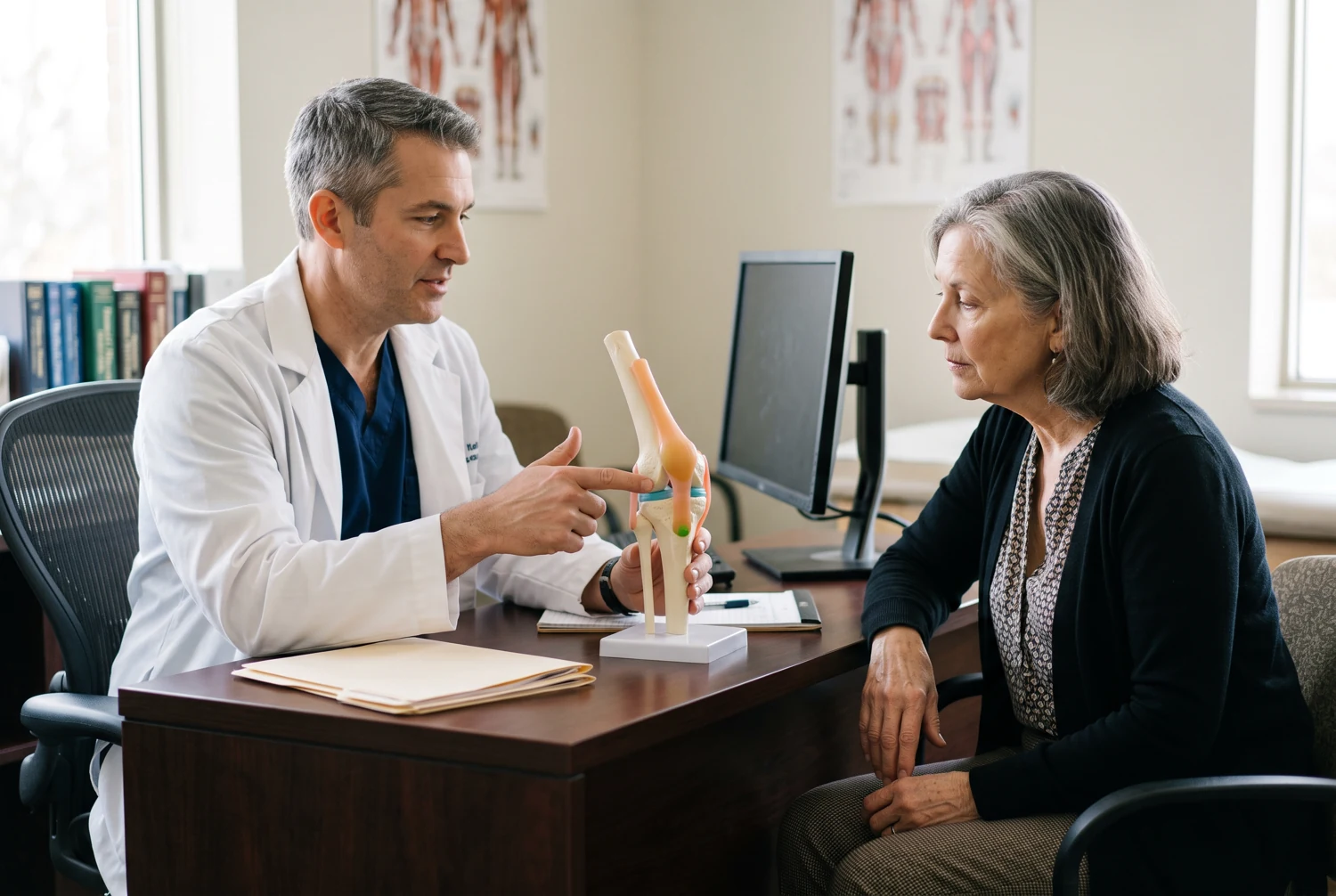
Ask your surgeon to show you one decision the robotic system would help them make in your knee. If you have a healed fracture, a plate or screws from earlier surgery, or a leg that does not straighten fully, bring that history and any available images. Ask how the team would plan around it with and without robotic assistance. RACER-Knee excluded people with a previous fracture, inflammatory arthritis, or a need for complex implants. RASKAL excluded people with major leg deformities or a knee that stayed bent more than 15 degrees even at its straightest. If one of those limits describes you, that trial’s results may not apply to your knee. An unusual knee deserves a specific explanation; it does not automatically make one technique the better choice. [1] [2] [4] [7] [21]
It is reasonable to ask how often the surgeon and operating-room team use the proposed system, which implants are compatible, and whether the surgeon would choose the same implant with conventional instruments. If the answer is that the robot helps the surgeon check balance, that is a concrete benefit to discuss. It is different from saying you will walk sooner. Conventional replacement is an established alternative, and choosing it does not mean forgoing surgical planning or checks on the fit. [1] [2] [4]
Before scheduling, ask the facility and your health plan for a written estimate for each realistic option. Check the surgeon, facility, planning scan, and physical therapy separately. Ask whether any part needs prior authorization and whether your own bill would change if conventional instruments were used. RACER-Knee found greater costs for robotic surgery in the UK health system; that does not tell you what a US insurer will cover or what you will owe. Include practical costs such as a second trip for imaging or an unpaid day away from work in your comparison. [2]
Plan recovery around your home and your surgeon’s instructions
Robotic assistance does not set your discharge date or rehabilitation schedule. Going home depends on how you are doing medically, whether you can move safely, how well you can manage pain, and what help is available. Tell the team before surgery if you live alone, your only bathroom is upstairs, or the person driving you home cannot stay overnight. Ask to practice the steps you actually have at home and, if help is limited, to speak with the discharge planner before the day of surgery. [3] [17]
Leave with your surgeon’s written instructions for how much weight you may put on the leg, which walking aid to use, when therapy starts, and how to care for the main incision and any pin sites. Ask the therapist to watch you get up from a chair or use your walker rather than just describing it. If you have diabetes, get a plan for blood sugar monitoring and medicines around surgery. If you take a blood thinner, have the surgical team and prescribing clinician clarify what to take and when. Do not stop, restart, or add a medicine based on someone else’s knee replacement instructions. [3] [8] [17]
Plan return to work by task rather than by the word robotic. Someone who can work seated from home faces a different first day than someone who climbs ladders, drives a delivery route, or stands through a shift. Bring a short list of those demands to follow-up. Ask what you need to be able to do safely, whether temporary duties would help, and when to reassess. Get individual guidance before driving; being able to walk to the car is not the same as being able to brake safely or drive without impairing medicine. [3] [12] [17]
Symptoms that should not wait after knee replacement
- Call 911 for new chest pain, sudden trouble breathing, coughing up blood, or fainting. These can signal a blood clot in the lungs or another life-threatening problem. Do not drive yourself or wait for the orthopedic office to call back. [17] [18]
- Go to the nearest emergency department now for sudden severe pain in your thigh, knee, or shin, a visible change in the shape of your leg, or a new inability to put weight on it. These can be signs of a broken bone, even if you did not fall. Have someone take you if travel is safe; call 911 if you cannot be moved safely or the situation may be life-threatening. Tell the emergency team about the replacement and any tracking-pin sites. [8] [19] [20]
- Call your surgical team right away if new pain in one spot near a thigh or shin pin site does not go away, even if you had no injury. Do not wait for a routine visit to report it. [19]
- New calf or thigh pain, tenderness, or swelling needs prompt assessment for a possible clot. Call your surgical team right away for urgent evaluation. If prompt assessment is unavailable, go to the nearest emergency department now with safe transport. Do not wait for a routine appointment. [17] [18]
- Call your surgical team right away for new or increasing wound drainage, spreading redness or discoloration, worsening tenderness, or chills. For fever, use the temperature your surgeon’s knee replacement discharge instructions give you for calling. If they give no number, call for a temperature of 100.4°F (38°C) or higher. Check separate pin sites as well as the main incision. Do not wait for a fever if the wound is worsening. [8] [17]
Questions to ask your physician
- Given what I want to do again, why do you recommend total replacement now, and what alternatives still make sense?
- What decision would robotic assistance help you make in my knee? How would you make that decision with conventional instruments?
- Which exact system and implant are you proposing? Do I need a new planning scan, or can you use my existing images?
- What does the device guide, what do you check by hand, and when would you switch to conventional tools?
- What evidence applies to my priority: less pain early on, easier stairs at a year, or a lower chance of another operation?
- Will I have separate pin sites? What should I watch for, and whom should I contact if something changes?
- What should I be able to do before going home, driving, or returning to my particular job? How should we plan around my stairs, transportation, and available help?
Learn More
- Hospital for Special Surgery: How surgeons map the knee, guide bone preparation, and test the fit
- RACER-Knee: Randomized comparison of robotic-arm-assisted and conventional total knee replacement
- American Academy of Orthopaedic Surgeons: Total knee replacement, risks, and recovery
- FDA device record: ROSA Knee System imaging options, planning, and cutting guide
- RadiologyInfo: Preparing for CT and discussing possible pregnancy with the imaging team
- Kim and colleagues: Randomized trial of function and long-term implant survival
- Study of two robotic knee systems: Tracking problems, experience, and conversion to conventional instruments
- Desai and colleagues: Tracking-pin wound complications and fractures after robotic-assisted total knee replacement
- American Academy of Orthopaedic Surgeons: Clinical practice guideline on surgical management of knee osteoarthritis
- University of Warwick: RACER-Knee investigators explain their findings
- ROAM randomized trial: Early pain and six-month function after robotic versus manual knee replacement
- ROAM follow-up: Pain, function, and quality of life over the first year
- RASKAL randomized trial: Robotic assistance versus computer navigation and two alignment strategies
- November 2026 analysis of randomized trials: X-ray alignment versus outcomes patients report
- American Joint Replacement Registry study: Five-year revision outcomes in Medicare patients
- UK National Joint Registry study: Implant survival after robotic and conventional knee replacements
- Mayo Clinic: Preparing for total knee replacement, recovering at home, and recognizing warning signs
- Houston Methodist: Recognizing a possible leg clot or pulmonary embolism and getting help
- Systematic review: Fractures through tracking-pin sites after knee replacement
- American Academy of Orthopaedic Surgeons: Symptoms and emergency evaluation of a fracture after total knee replacement
- RASKAL trial protocol: Which patients could take part
- RASKAL investigators: Trial funding disclosure