

A partial-thickness rotator cuff tear affects some of the depth of a tendon. A full-thickness tear goes through its entire depth in at least one spot. A full-thickness tear can be narrow. The terms describe depth; the report may separately describe width, which tendon is involved, and whether the torn edge has pulled away. Your symptoms, strength, and goals help determine which findings matter. [1] [2]
What the two terms describe
The rotator cuff is a group of muscles and tendons that help lift and rotate the arm and keep the upper arm bone centered in the shoulder socket. A partial tear may affect the side of the tendon that faces the joint or the side that faces the bursa. Tissue remains continuous through part of its depth. In a full-thickness tear, the defect reaches from one surface to the other. Ask the clinician to show you that distinction on your image or a model. [1] [2]
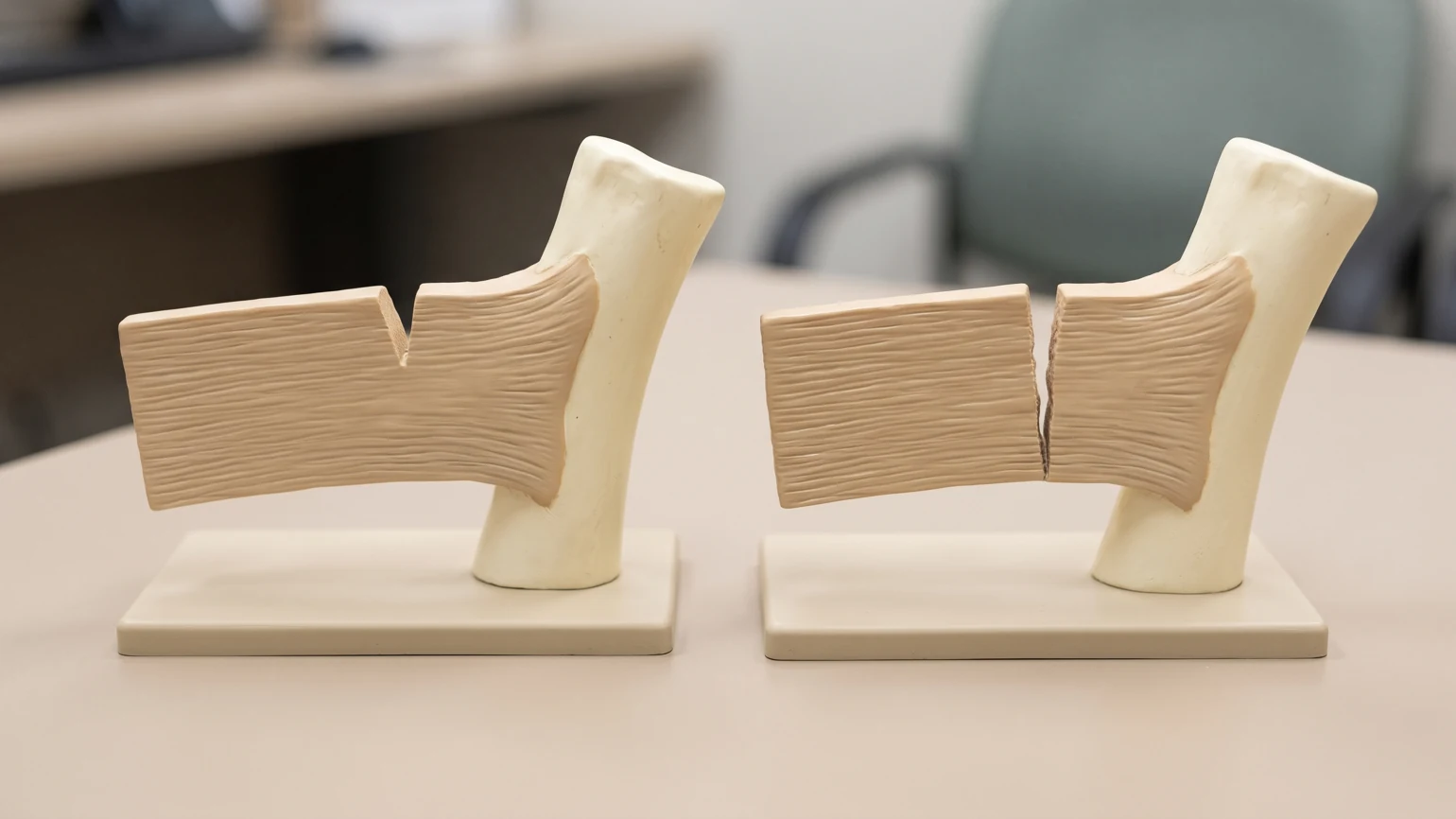
These teaching models show the difference in depth. The width of the damaged area is a separate measurement. [1] [2]
- Partial-thickness tear. Tendon tissue remains continuous beneath the notch.
- Full-thickness tear. The narrow defect reaches both surfaces of the tendon.
What pain and weakness add to the report
Some tears cause pain with reaching or lifting, weakness, or pain when lying on that side. Some people with a tear on imaging have no symptoms. The clinician will ask how the problem started, what you were able to do before, and whether you were suddenly unable to raise the arm after an injury. New difficulty lifting the arm after a fall or another injury warrants prompt evaluation. Tell the clinician which tasks hurt and which feel genuinely weak. [1] [2]
What the exam and imaging can show
Your clinician may compare movement and strength on both sides and consider other sources of shoulder or arm symptoms. X-rays can help evaluate bone or arthritis. When the history and exam suggest a cuff tear, ultrasound or MRI can help show tendon damage. MRI may also show the extent of the tear, whether an edge has pulled away, and changes in the muscle. For example, a report can describe a tear as full thickness and only a few millimeters wide. Ask what the report says about muscle quality, too. Imaging complements the exam and cannot determine on its own why you hurt or which treatment fits. [1] [2]
How tear depth can affect your options
Physical therapy and other nonsurgical care can help some people manage symptoms and improve function. AAOS discusses repair for selected high-grade partial tears after nonsurgical care has failed. For full-thickness tears, clinicians also consider how the injury happened, the demands on the arm, the extent of the tear, and tendon and muscle quality. Ask what improvement would be realistic with each option and what the clinician would monitor if you start with nonsurgical care. [1] [2]
In a randomized study of people with tears up to 3 centimeters, those assigned to early repair reported less pain and had better average shoulder scores at 15 years than those assigned to physical therapy with the option of later repair. Some people assigned to therapy later had surgery. These results apply to the tears and patients studied. [3]
If you and your surgeon choose an operation, ask them and your therapist about the sling, lifting limits, and when movement or strengthening can begin. The timing depends on the tear and the operation. A general shoulder exercise plan cannot replace the rehabilitation instructions for a specific repair. [1] [2]
Questions to bring to your visit
- Which tendon is involved, and what are the depth and width of the tear?
- Does the image explain the weakness or the tasks I find difficult?
- Given my work or activities, what can I reasonably expect from each treatment option?
- How would we know when to reassess the plan?