
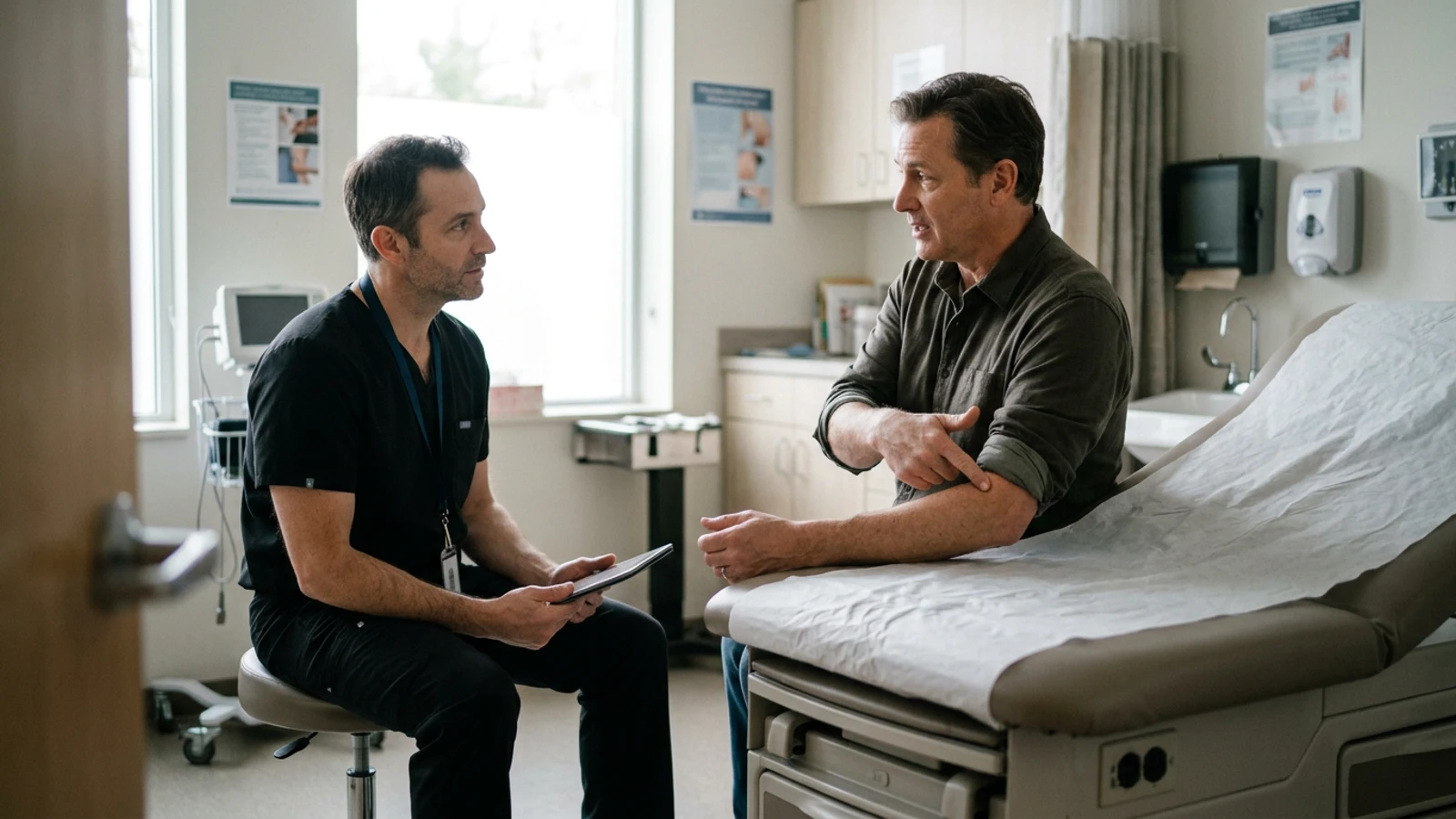
Tennis elbow usually hurts on the outside of the elbow; golfer’s elbow usually hurts on the inside. Both can make it painful to grip a handle, lift a pan, or turn a tool, even if you’ve never played either sport. The most useful clues are where the pain starts, what your hand is doing when it hurts, and whether it began gradually or with an injury. Those details help us decide whether to focus on a tendon or examine a nearby nerve, ligament, or bone. [1] [2] [3]
Why the same grip can hurt on different sides
With your arm at your side and your palm facing forward, the outer elbow is on the thumb side and the inner elbow is on the little-finger side. The bony bump on each side is an attachment point for tendons, the strong bands of tissue that connect muscle to bone. When you squeeze a handle, some forearm muscles close your fingers while others steady your wrist. That’s why a sore elbow can announce itself during a task that barely seems to move the elbow at all. [1] [2]
Tennis elbow, also called lateral epicondylitis, involves the outer attachment of muscles that lift the wrist backward. One of these muscles helps hold the wrist steady when the elbow is straight. You might notice a burning or aching spot on the outside when you lift a skillet by its handle, shake hands, or hold a racket through a backhand. The discomfort often builds over weeks rather than starting with one memorable injury. [1]
Golfer’s elbow, or medial epicondylitis, involves the inner attachment of muscles that bend the wrist toward the palm and turn the forearm palm-down. Wringing out a cloth, squeezing pruning shears, or gripping a club through a swing may bring on an ache at the inner bump. The pain can extend down the forearm, and making a fist may feel stiff or uncomfortable. It often builds gradually, although some people notice it after a particular effort. [2] [3]
A jar lid is a good example of why the task alone can’t identify the condition: opening it takes both a squeeze and a twist. At a visit, it’s more useful to point to where the pain starts and describe which part of the job hurts than to repeat the motion until it hurts again. [1] [2]
When it may be an injury rather than overuse
If you suspect a dislocation, call 911 before giving first aid. An elbow that looks out of place after a fall is one sign. Keep the arm still in the position you found it. Don’t try to straighten it or push the joint back into place. Also call 911 if bone has come through the skin, bleeding is severe, the skin below the injury is pale, cold, blue, or clammy, or you suspect a break and can’t keep the injured arm still on your own. [4] [5]
Get medical help right away if an injury makes it hard to bend or straighten your elbow or use your arm normally. Even without a fall, get medical help right away if you can’t bend the elbow, it locks and won’t release, or it feels warm and swollen and you also have a fever. [3] [6] If you develop new numbness or tingling in your hand after an elbow injury, get medical help right away. [4]
If you think your elbow may be broken but none of these warning signs apply, keep the arm still and get prompt medical care. Call your clinician to ask where to be seen. [4]
A pitcher who feels a pop at the inner elbow and can’t continue throwing may have injured the ulnar collateral ligament. This ligament connects bone to bone and helps steady the elbow during a throw. Stop throwing rather than trying another pitch to see if the arm holds up. A gradual loss of speed or control along with inner-elbow pain is also worth reporting. [6] [7]
For a child or teen who is still growing, the same sore spot can be a growth-plate injury rather than adult golfer’s elbow. A young athlete should stop throwing when the elbow hurts. If the pain persists after a few days of rest or comes back when throwing resumes, keep the athlete out of throwing and arrange an evaluation. An adult strengthening program is not a substitute for that assessment. [8]
What tingling in the ring and little fingers means
The ulnar nerve passes just behind the inner elbow bump, at the funny bone. It supplies feeling to the little finger and the adjacent half of the ring finger. Irritation there can cause pins and needles when you hold a phone with the elbow bent, lean on an armrest, or sleep with the arm folded. It can coexist with golfer’s elbow. An ache down the forearm and a finger that actually feels numb are different symptoms; tell us if you have both. [2] [9] The advice below is for symptoms that come on gradually, such as tingling when you keep the elbow bent. If numbness or tingling in your hand is new after an injury, get medical help right away. [4] [9]
There’s also a difference between letting go of a mug because gripping hurts and having trouble coordinating your fingers to turn a key or fasten a button. Contact your clinician promptly for severe nerve symptoms, especially hand weakness or loss of finger coordination. Arrange a visit if symptoms interfere with ordinary activities. The American Academy of Orthopaedic Surgeons also advises evaluation for milder symptoms lasting more than six weeks. Don’t wait six weeks if hand function is getting worse. [9]
What we look for at an elbow visit
In an elbow evaluation, we start with the story and the exam. We check where the elbow is tender, how it moves, and which movements reproduce your familiar pain. For outer-elbow pain, that may mean lifting your wrist against gentle resistance. For inner-elbow pain, we may check wrist bending and palm-down rotation, then examine hand strength and sensation. Tell us what changed just before this began, whether that was a fall, a different tool at work, or more time on the court. [1] [2] [9]
If the elbow caught and then released, describe that episode even if the joint moves normally at the visit. In a study of people seen for outer-elbow pain, locking and sudden onset were among the clues associated with a diagnosis other than tennis elbow. They weren’t a home test for any one condition. Our guide to other causes of outside elbow pain explains what we consider when the outer-tendon pattern doesn’t fit. [10]
An MRI is not required just to distinguish inside from outside tendon pain. When imaging is needed for persistent elbow pain, X-rays are usually the first study. They can show arthritis or a bone injury but don’t show the tendon well. If X-rays don’t explain the symptoms and treatment hasn’t helped, ultrasound or MRI without contrast can be useful for a suspected tendon problem or tear. A nerve conduction study answers a different question: whether a nerve is compressed and where. [2] [9] [11]
Adjusting work, home tasks, and sport
For either tendon condition, start by identifying the part of a task you can change. Someone who gardens for pleasure may be able to put aside the shears. A mechanic who needs a wrench all day may have more flexibility about which jobs to alternate than about whether to use the tool at all. Tell your clinician what you can’t avoid so the plan is realistic. [1] [2] [12]
- At home: If a full pot hurts to lift by one handle, consider a smaller pot or use both handles when safe. Notice whether the weight, the tight squeeze, or the wrist position makes the most difference. [1] [2]
- At work: Describe one shift in concrete terms: what you hold, how hard you grip, and how long you repeat it. If modified duties are available, ask for restrictions your supervisor can act on, such as alternating away from prolonged tool use. [1] [12]
- In sport: If pain followed a change in racket, club, practice volume, or technique, bring that detail to the visit. A therapist or coach can review your grip and stroke before you spend money replacing equipment. [1] [2]
A forearm strap or wrist support is an option for comfort during a difficult activity, not a requirement. For tennis elbow, a support may help while you’re wearing it; lasting benefit is less certain. For golfer’s elbow, a strap can sometimes make forearm pain worse. If the task hurts more with the strap on, take it off and ask whether a different fit or no strap makes more sense. [2] [12]
A cold pack wrapped in cloth is one option for soreness. [2] Before taking an over-the-counter pain medicine, ask your doctor or pharmacist whether it’s right for you and read the current Drug Facts label on your package. [13]
Does physical therapy help both conditions?
For tennis elbow that has persisted beyond the earliest stage, a U.S. physical therapy guideline recommends exercises that work the wrist-lifting muscles against resistance. Depending on the exam, that might mean holding the wrist still against a load or controlling it as it moves. The therapist can measure how strongly you can grip before pain starts and connect that finding to a goal, such as carrying a toolbox. The guideline doesn’t prescribe the same exercise or number of visits for everyone. [12]
How much faster therapy will help than time and advice alone is less certain. The Canadian Shoulder and Elbow Society reviewed trials that compared strengthening exercises with no active treatment in adults with tennis elbow. In a separate randomized trial, adults with tennis elbow lasting at least six weeks did better at six weeks with hands-on therapy plus exercise than with a wait-and-see approach. By one year, most people in both groups reported improvement, with no clear difference between them. If symptoms are easing and you can manage your tasks, monitoring with a follow-up plan is an option. If work is difficult now, help adapting that work may matter even without a guaranteed long-term advantage. [14] [15]
For golfer’s elbow, rehab generally focuses on different movements: bending the wrist and turning the palm down. In one study, people with persistent golfer’s elbow added an exercise that worked the wrist-bending muscles as they lengthened. Their arm function improved, but the exercise was only one part of their treatment. The study can’t tell us how much the exercise itself helped. It isn’t evidence that the same exercise treats tingling fingers. [2] [16]
If physical therapy is part of your plan, our physical therapy and rehabilitation team is one option. You can choose a therapist elsewhere or ask whether a home program with follow-up is appropriate. At the first visit, practice the movement you’ll be doing on your own and ask what response should prompt an adjustment. If transportation, shift work, or cost makes appointments difficult, say so before booking a course of visits. Ask what you can do at home and what the therapist needs to reassess in person. [12] [15]
Cortisone and PRP: what to know before choosing a shot
Cortisone for tennis elbow: Quick relief can be appealing when you need to work. A randomized trial followed 165 adults who had pain on the outside of one elbow for more than six weeks. Over the following year, symptoms recurred in 54% of those assigned to a corticosteroid shot versus 12% assigned to a placebo shot. Recurrence meant feeling recovered or much better at four or eight weeks, then losing that improvement. At one year, 83% of the steroid group felt recovered or much better, compared with 96% of the placebo group. At 26 weeks, the figures were 55% and 85%, respectively. Those numbers describe this group; they are not estimates for golfer’s elbow. [17]
Cortisone for golfer’s elbow: A trial compared a steroid injection with saline. Both groups also received numbing medicine, physical therapy, and anti-inflammatory medication. The researchers found no pain advantage at three months or one year. If you’re considering a shot for the inner elbow, discuss possible temporary relief rather than expecting a lasting difference. [18]
Before a steroid injection, tell the clinician if you take a blood thinner or have diabetes. Steroids can temporarily raise blood glucose; if you have diabetes, ask how to monitor it after the shot. Ask about skin changes, risks to nearby tendon tissue, and what activities to avoid. Follow your own discharge instructions, including your return-to-work plan. Call the office that gave you the shot if you develop fever or chills, your pain gets much worse, or you notice redness, warmth, or any drainage at the injection site. [19]
Platelet-rich plasma (PRP) uses platelets concentrated from your own blood. For tennis elbow, the key question is whether PRP helps more than a placebo shot. In one small trial of persistent tennis elbow, researchers found no clear advantage for PRP over saline in pain or function at one year. Another small trial favored PRP over saline on a patient-rated measure of elbow pain and function, but not everyone who enrolled was included in the final analysis. With small studies giving different results, it’s hard to predict how much more relief PRP would provide than a placebo shot. [14] [20] [21]
A separate trial compared four active treatments for persistent tennis elbow: physical therapy, shockwave therapy, prolotherapy (another injection treatment), and PRP. Without a placebo group, the trial could compare those options but couldn’t establish how much improvement came from PRP itself. It didn’t study golfer’s elbow. [22]
For persistent golfer’s elbow, a small study compared records of patients who had PRP or surgery after initial care hadn’t helped. It included people without accompanying ulnar nerve irritation. The groups weren’t assigned at random; similar outcomes on some measures don’t establish that the treatments are equivalent. [23] Before paying for PRP, ask what evidence applies to your diagnosis and what continuing without an injection would look like. To find out what you would owe, check with the clinician offering it and your insurer.
Returning to activity and reassessing the plan
Choose a familiar task as a progress marker. Being able to pour coffee one-handed again is meaningful, even if carrying a full tray is still uncomfortable. For a return to work or sport, describe the harder goal as well: how heavy the tray is, how often you carry it, or whether your grip holds up late in practice. A gradual return lets you separate those demands rather than adding weight, speed, and repetition all at once. [2] [12]
If you’re not getting better with home care, make an appointment. At follow-up, tell us what is easier, what remains out of reach, and whether the symptoms have changed. Persistent limits after months of nonsurgical care may warrant a specialist discussion, including whether a procedure offers a meaningful benefit over continued care. Time alone doesn’t make that decision. The diagnosis, your ability to use the arm, and the recovery demands of a procedure matter more than reaching a date on the calendar. [1] [2] [6]
Questions to ask your physician
- Which finding points to the outer or inner tendon attachment in my case? Does the tingling or hand weakness suggest a nerve problem too?
- Which part of my work, caregiving, or sport should I modify first, and what can I keep doing?
- What would supervised therapy add to a home plan for me? How will we tell if either is helping?
- Would an X-ray, ultrasound, MRI, or nerve test change what we do next?
- If we’re considering an injection, what did studies find for my side of the elbow, both early and later? What are the risks and costs of choosing it now versus waiting?
- What change should bring me back sooner, and what should I be able to do before returning to full duty or play?
Learn More
- American Academy of Orthopaedic Surgeons: Tennis elbow (lateral epicondylitis)
- American Academy of Orthopaedic Surgeons: Medial epicondylitis (golfer’s elbow)
- Cleveland Clinic: Golfer’s Elbow (Medial Epicondylitis)
- MedlinePlus Medical Encyclopedia: Broken bone first aid and when to call 911
- MedlinePlus Medical Encyclopedia: Dislocation first aid and when to call 911
- MedlinePlus Medical Encyclopedia: Elbow Pain and When to Call a Medical Professional
- American Academy of Orthopaedic Surgeons: Elbow Injuries in the Throwing Athlete
- American Academy of Orthopaedic Surgeons: Throwing injuries in children’s elbows
- American Academy of Orthopaedic Surgeons: Ulnar nerve entrapment at the elbow
- Zwerus and colleagues: Clinical clues to diagnoses other than tennis elbow
- American College of Radiology: Appropriateness Criteria for chronic elbow pain
- Lucado and colleagues: Physical therapy clinical practice guideline for lateral elbow pain
- DailyMed: Ibuprofen 200 mg over-the-counter Drug Facts label
- Canadian Shoulder and Elbow Society: Position statement on nonsurgical management of lateral epicondylitis in adults
- Bisset and colleagues: Randomized trial of mobilization with exercise, steroid injection, or waiting for tennis elbow
- Tyler and colleagues: Wrist-flexor exercise added to rehabilitation for persistent golfer’s elbow
- Coombes and colleagues: Placebo-controlled trial of corticosteroid injection with or without physical therapy for one-sided lateral elbow pain
- Stahl and Kaufman: Randomized trial of corticosteroid injection for medial epicondylitis
- UTHealth Houston, McGovern Medical School: Steroid injection risks and aftercare
- Dejnek and colleagues: Randomized comparison of PRP, corticosteroid, hyaluronic acid, and saline for lateral elbow tendinopathy
- Randomized trial comparing PRP, corticosteroid, and saline for tennis elbow, with patient-reported and imaging outcomes
- Lhee and colleagues: Two-year randomized comparison of physical therapy, shockwave therapy, prolotherapy, and PRP for persistent tennis elbow
- Bohlen and colleagues: Retrospective comparison of PRP and surgery for persistent golfer’s elbow without ulnar nerve involvement